 Skip to content

The practical answer
A useful furniture packing brief describes the product’s weak points, expected handling, support method, outer package, labels and acceptance evidence. Choose protection for the actual item and transport plan. More wrapping does not compensate for an unsupported surface, a weak base or an unidentified package.
Specify the risk for each product
| Product | Points to discuss with the packer |
|---|---|
| Upholstered seating | Clean dry surfaces, abrasion protection, supported feet and approved stacking restrictions |
| Cabinetry | Corner protection, secured moving parts, hardware identification and load-bearing points |
| Glass or stone | Purpose-designed support, edge protection, orientation and lifting method |
| Lighting | Isolation of fragile components, fitted cushioning and separately identified accessories |
These are discussion points, not engineering specifications. Heavy stone, oversize items and unusual lifting arrangements require a competent packing and handling plan based on actual dimensions, weight and support requirements.
Make the brief measurable
For each item, record the product ID, photographs, unpacked dimensions, weight, fragile surfaces and allowed orientation. Ask the packer to propose the finished package dimensions and weight, base design, forklift access, lifting points and stacking limit. State the receiving site’s constraints so protection can be removed safely at destination.
A useful acceptance instruction is “show the supported tabletop and edge protection before closing the crate,” rather than “pack very well.” Agree who approves a different material or crate design. Do not use a material thickness copied from an unrelated machinery manual as a universal furniture standard.
Treat moisture as a system
Dry goods, dry packaging and an appropriate moisture-control plan work together. Sealing damp goods inside plastic can preserve the moisture problem. UNECE’s CTU packing guidance addresses moisture sources and the limitations of protective measures. [1] Ask the packing team to select any barrier or desiccant arrangement for the product, package and voyage conditions.
Document visible dampness, mould, staining or odour before loading. Do not close a questionable package merely because the truck has arrived. Escalate the condition and record the agreed corrective action.
Build an inspection photo sequence
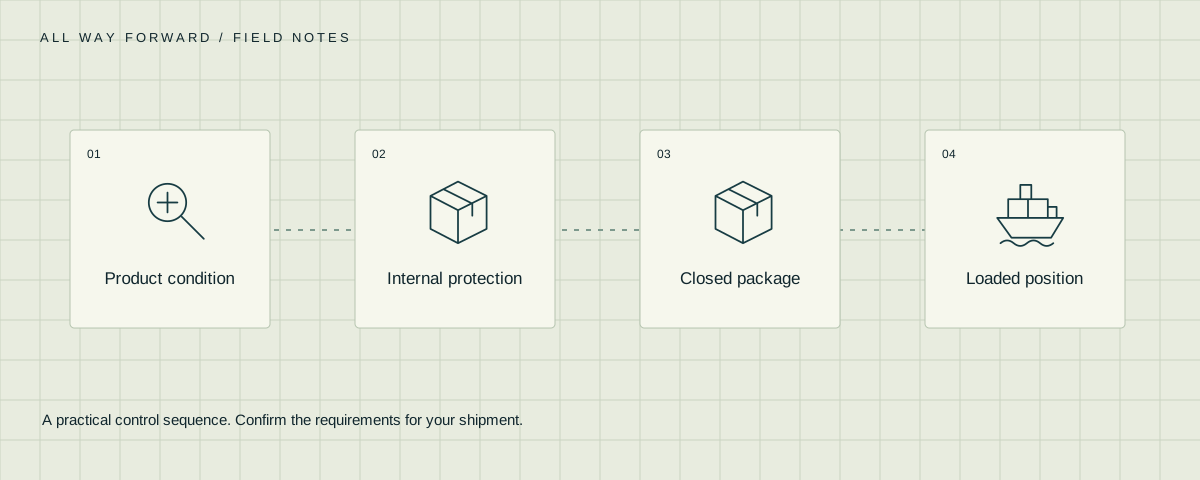
Capture the item identifier and condition before packing; the internal support and protection before closure; the closed package and readable marks; and the package in the final load. Include a scale or measurement reference where useful. A general warehouse photograph cannot establish the condition of a specific item.
Label the final package with a stable shipment and package reference. Keep accessories tied to the parent item, for example “cabinet 07 — hardware box.” Re-measure after repacking and update the consolidated packing list. For solid-wood crates, pallets or dunnage, complete the separate wood-packaging compliance check before dispatch.
Use before the next handoff
Your action checklist
Ticks stay in this browser. No shipment details are sent.
Common questions
Does a wooden crate guarantee protection?
No. The base, support, cushioning, fixing, handling method and product characteristics determine whether the crate is suitable.
Should I photograph only the finished package?
Keep photographs before closure as well. They can show product condition, internal protection and support that the closed package hides.
Sources & scope
Primary references checked 21 October 2026. Carrier examples describe that provider’s process; confirm the requirements of your own booking and destination.
Editorial preparation: Allwayforward Editorial Team. The worksheets and worked examples are original planning aids, not carrier forms or a substitute for shipment-specific instructions.