 Skip to content

The practical answer
Before loading, inspect the actual container and confirm it suits the cargo. Read its identity and weight markings, check condition and access, and approve the loading plan. After packing, record the load and seal, determine VGM by an accepted method and submit it before the booking deadline.
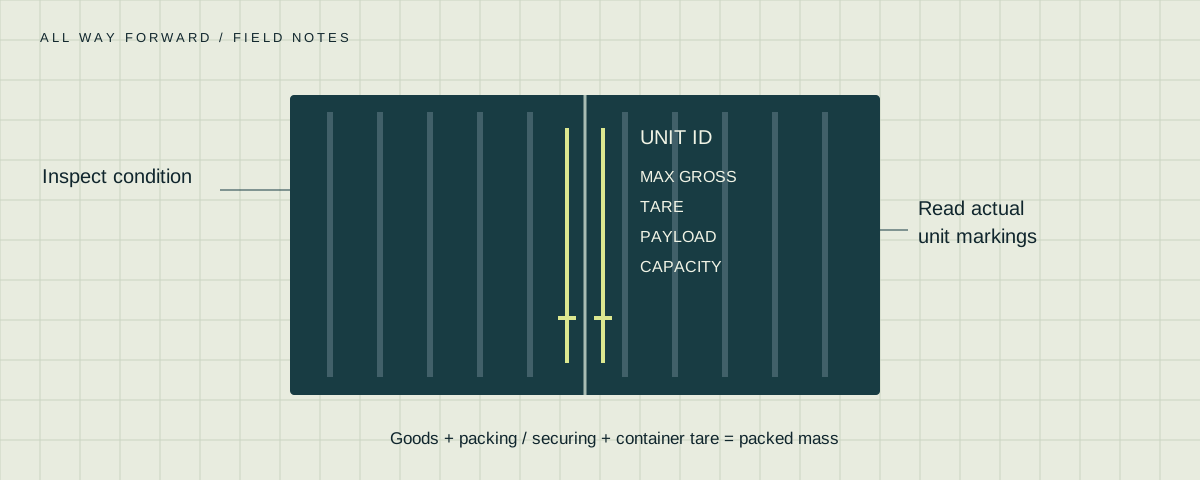
Inspect the assigned unit
Match the container number to the release instruction and equipment interchange record. Photograph existing damage and make sure the record reflects the condition before accepting the unit. Check the floor, roof, walls, doors, seals, cleanliness, odour, visible water ingress and usable securing points. Ask for a replacement or competent assessment when a defect may affect the cargo.
Confirm the actual door opening and usable internal dimensions for large crates. Standard container descriptions are planning references; the specific unit, route and handling arrangement control what can be accepted.
Read the weights correctly
BIC identifies the container number, size/type code, maximum gross mass, tare and other door markings. Maximum gross mass includes the container itself; it is not the weight of goods you may add. [1]
| Term | Meaning for the check |
|---|---|
| Cargo gross weight | Goods and their packaging; label what is included |
| Container tare | Empty container mass for the actual unit |
| Maximum gross mass | Marked maximum for container plus load |
| VGM | Verified gross mass of the packed container |
Illustrative arithmetic: cargo including packaging of 12,000 kg + additional securing material of 150 kg + container tare of 3,800 kg gives 15,950 kg. Do not count the same pallet or dunnage twice. Arithmetic alone does not establish compliance with an approved VGM method, a road limit or a safe load distribution.
Check distribution as well as totals
A load can be below the maximum mass and still be unsafe because of concentrated weight, unsupported items or ineffective restraint. Ask the packing team to review floor loading, centre of gravity, compatibility, lifting access and securing. The CTU Code is a reference for competent packing and securing practice. [2]
Photograph the empty interior, loading stages, final restraint and closed doors. Record the seal number clearly and match it to the shipment record. A seal supports chain-of-custody checks; it does not prove the cargo was correctly packed.
Submit and confirm VGM
IMO guidance describes two approaches: weighing the packed container, or using a certified method to establish the mass of cargo and packing materials and adding the container tare. The shipper must communicate VGM through the required channel in time for vessel planning. [3]
Confirm the accepted weighing arrangement, responsible shipper, submission channel and cutoff for this booking. Save the weighing or calculation evidence and submission acknowledgement with the container reference. If cargo or equipment changes after weighing, ask how VGM and associated documents must be corrected.
Use before the next handoff
Your action checklist
Ticks stay in this browser. No shipment details are sent.
Common questions
Can I use a standard container tare from a chart?
Use the actual unit’s tare and the accepted weighing procedure. A generic chart can differ from the equipment supplied.
Does the container payload limit cover road transport?
Not by itself. The road, vehicle, axle, route and local handling restrictions must also be checked.
Sources & scope
Primary references checked 21 October 2026. Carrier examples describe that provider’s process; confirm the requirements of your own booking and destination.
- BIC — Container markings ↗
- IMO / ILO / UNECE — CTU Code ↗
- IMO — Guidelines regarding verified gross mass, MSC.1/Circ.1475 ↗
Editorial preparation: Allwayforward Editorial Team. The worksheets and worked examples are original planning aids, not carrier forms or a substitute for shipment-specific instructions.