 Skip to content
The practical answer
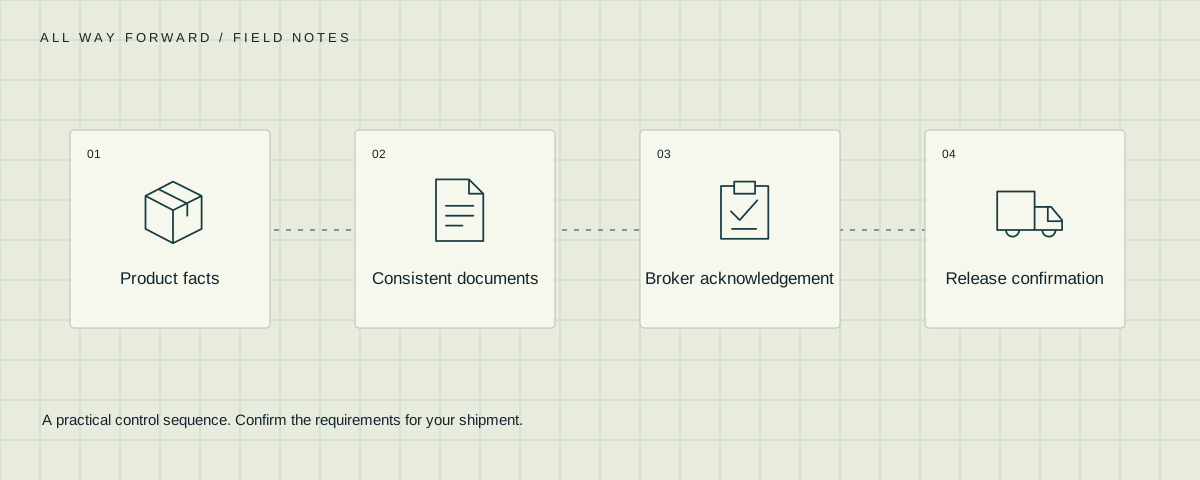
Give the customs broker a consistent product and shipment record before the required filing deadlines. Identify the importer and exporter, provide accurate descriptions, values, origin and packing data, and ask the broker to confirm missing permits or filings. A broker handoff is not complete until the responsible party acknowledges it.
Name the responsible parties early
Identify the actual exporter, importer, seller, buyer and broker. Ask which party is authorized to make each declaration and what authorization is required. Do not borrow another company’s identity or reuse old paperwork to make a shipment appear simpler. The commercial records and declarations must represent the real transaction.
Agree the destination country and clearance point before booking. For the United States, CBP publishes guidance for new importers and exporters; other destinations need their own current authority and broker review. [1] A generic international checklist cannot determine the tariff treatment of an individual product.
Build the product record before the shipment record
| Provide | Useful detail |
|---|---|
| Product identity | Plain description, material, function, model and relevant specifications |
| Commercial transaction | Seller, buyer, invoice currency, price and agreed sale terms |
| Origin information | Manufacturing origin and supporting records; separate from the shipping location |
| Packing data | Item quantities, package hierarchy, marks, net and gross weights |
| Transport | Booking and document references, route, expected dates and parties |
| Regulated characteristics | Relevant wood, batteries, chemicals or other controlled components to assess |
For a mixed furniture order, “furniture” alone may be too vague for classification. Supply product-level details, for example the frame material and intended use of a chair. Ask the broker to confirm the classification and required evidence; do not infer a duty rate from a broad category name.
Separate advance filings from arrival clearance
Some data is needed before loading. For U.S.-bound vessel cargo, CBP describes advance ISF requirements, including a deadline at least 24 hours before loading for specified data elements. The importer or agent must confirm the applicable filing, data and timing for the shipment. [2] Do not wait for the arrival notice to ask who is responsible.
Record the filing owner, internal data deadline, submission acknowledgement and any correction request. An email containing attachments does not establish that a filing has been accepted. If the broker identifies a mismatch, update the source record and circulate the change to the document issuer as needed.
Close the handoff loop
Ask the broker for a short missing-information list and confirmation of the next milestone. Keep invoices, packing lists and amendments under clear version names. Avoid circulating several files named “final” with different totals. The coordinator should know which version was used for each declaration.
For examinations, additional documents or holds, record the request, owner, response and current status. Do not promise an automatic clearance time or assume every inspection will require the same documents. Before delivery, obtain the applicable release confirmation and check the carrier and terminal gates independently.
Use before the next handoff
Your action checklist
Ticks stay in this browser. No shipment details are sent.
Common questions
Is the country of dispatch always the country of origin?
No. Record where the goods were manufactured and provide the evidence the broker requires. Shipping from a country does not by itself establish origin there.
Can a freight quote determine the final duty amount?
Not without the relevant product classification, valuation, origin and current destination rules. Ask who prepares the estimate and who is responsible for assessed charges.
Sources & scope
Primary references checked 21 October 2026. Carrier examples describe that provider’s process; confirm the requirements of your own booking and destination.
Editorial preparation: Allwayforward Editorial Team. The worksheets and worked examples are original planning aids, not carrier forms or a substitute for shipment-specific instructions.