 Skip to content

The practical answer
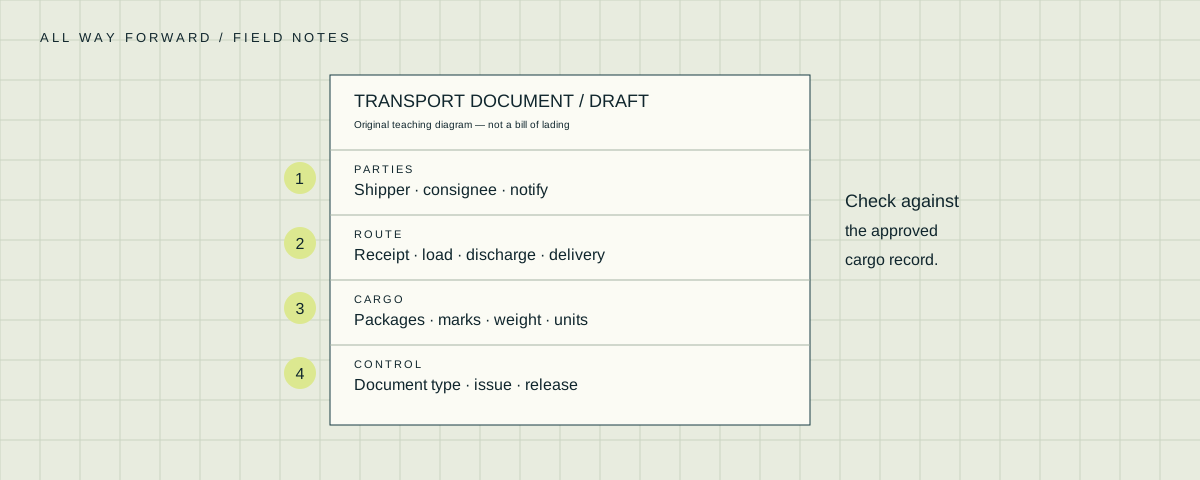
Approve a bill of lading draft only after matching it to the latest shipping instructions and final cargo record. Verify the parties, route, cargo description, package count, weights, container and seal details, and release requirements. A draft is a review document, not proof that cargo has been released.
Use the right reference documents
Gather the accepted booking, approved shipping instructions, final packing list, commercial invoice, loading record and any bank documentary requirements. Identify whether you are checking a house bill, a master bill or both. Their parties can differ because they represent different contractual relationships; do not copy one onto the other without the issuer’s review.
Ask who must approve changes and by when. Shipping instructions generate the draft transport document; Maersk describes issuing a verify copy after processing those instructions. [1] Check the new draft after an amendment rather than assuming a requested change was accepted.
Check these fields in a fixed order
| Field group | Cross-check | Typical mismatch |
|---|---|---|
| Parties | Legal names, addresses, consignee instructions and notify contact | Trading name substituted for the required legal party |
| Route | Receipt, loading, discharge and delivery locations | Discharge port mistaken for the final delivery address |
| Cargo | Description, marks, outer package count, weight and units | Number of products used as number of crates |
| Equipment | Actual container number and seal record | Booking reference pasted into the container field |
| Issue and release | Document type, approved freight notation and relevant issue details | Release assumed from a PDF copy alone |
Keep package count and product quantity distinct
Example: 60 dining chairs are packed into 15 cartons and palletized into 3 handling units. The invoice can state 60 chairs, while transport documentation must accurately describe the relevant packaging hierarchy according to the issuer’s instructions. Give the issuer all three numbers and ask how the outer units and contents should be described.
Label kilograms and cubic metres explicitly. Distinguish cargo gross weight from the verified gross mass of a packed container. VGM includes the container’s tare; blindly using it as the cargo weight can introduce a material error.
Approve facts, then preserve the approved version
Send an explicit approval tied to the draft number or timestamp. If there is an error, identify the field, current value, proposed correction and supporting record. Ask whether customs data, a manifest or another document also needs amendment. Changes after issuance may involve additional controls, fees or original-document handling.
Never backdate an actual shipment event to satisfy a purchase-order deadline, and never hide known cargo or packaging damage by asking for an inaccurate description. Raise the discrepancy with the commercial parties and document issuer. Keep the approved draft, final document and amendment correspondence together.
Use before the next handoff
Your action checklist
Ticks stay in this browser. No shipment details are sent.
Common questions
Is a bill of lading copy enough to collect cargo?
Not by itself. The issuer’s release process, document type, identity checks, customs status and terminal or warehouse conditions still need to be satisfied.
Must the house and master bills name the same parties?
Not necessarily. They can represent different contractual relationships. The responsible issuers must confirm the correct details and release arrangements.
Sources & scope
Primary references checked 21 October 2026. Carrier examples describe that provider’s process; confirm the requirements of your own booking and destination.
- Maersk — Shipping instructions and verify copy ↗
- IMO — Guidelines regarding verified gross mass, MSC.1/Circ.1475 ↗
Editorial preparation: Allwayforward Editorial Team. The worksheets and worked examples are original planning aids, not carrier forms or a substitute for shipment-specific instructions.