 Skip to content

For air freight customs clearance USA shipments, prevent mismatches by checking the invoice, manufacturer, consignee, classification, value, and required permits before dispatch. Confirm who will resolve discrepancies and verify customs release separately from terminal availability. These checks support preparation; they do not guarantee clearance or delivery by any promised date. [1][2][3]
Build One Consistent Shipment Record Before Dispatch
CBP recommends learning applicable procedures and commodity-specific requirements before importing. It also stresses being able to describe the merchandise accurately when seeking help. For China exporters and US buyers, the practical starting point is therefore a clear product record—not merely a booking reference or a broad description such as “parts.” [1]
As a recommended workflow, create one reviewed shipment record that the exporter, buyer, forwarder, and customs broker can use. Include the product description, manufacturer, consignee, proposed classification, transaction value, quantities, and any permit questions. This is an operational inference from CBP’s preparation advice and the invoice’s clearance role, not a prescribed universal form. [1][3]
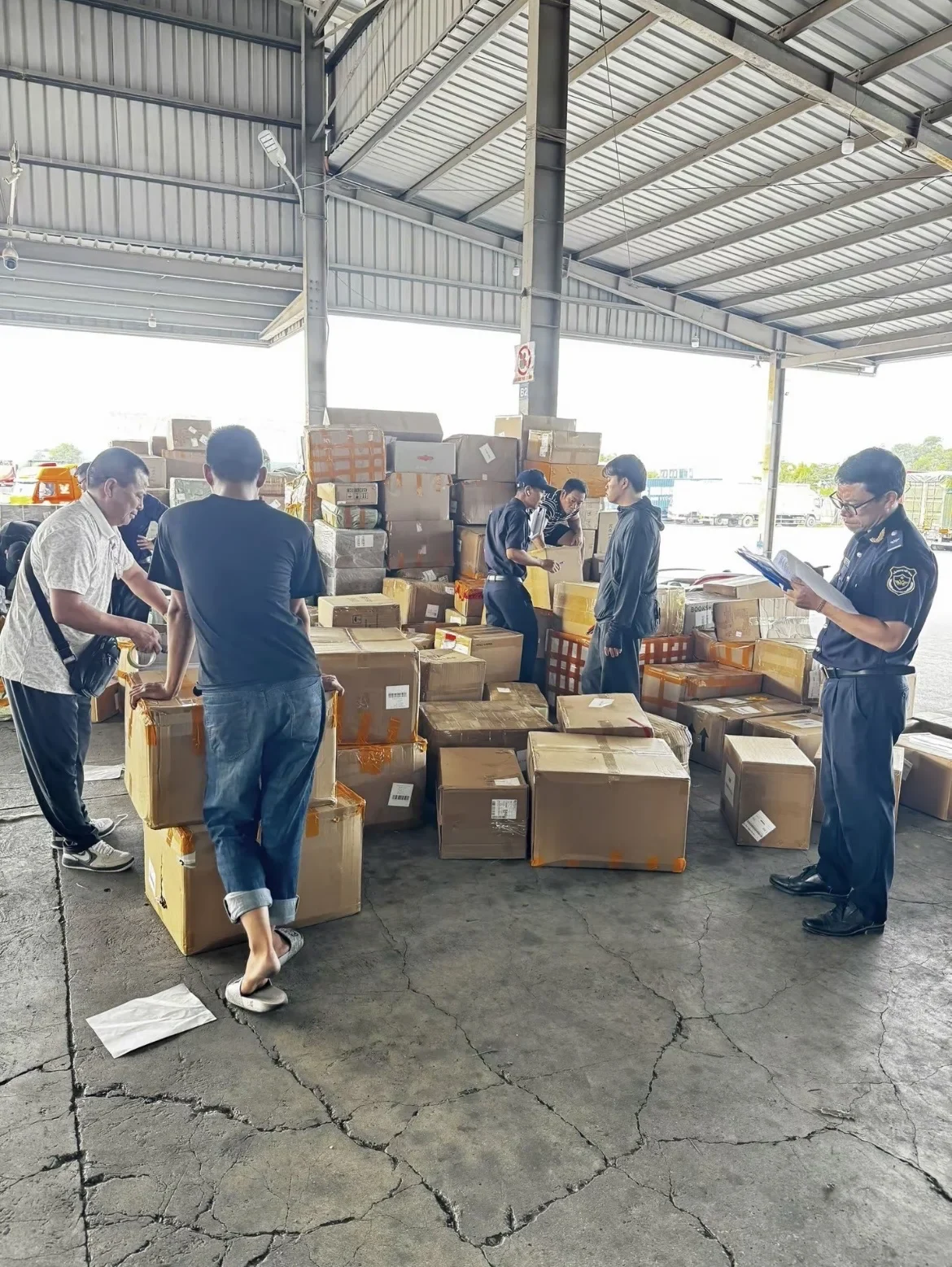
Consistency does not mean making every company name identical. A manufacturer, seller, buyer, and consignee may have different roles; one business may also perform several roles. The review should explain those relationships rather than overwrite genuine differences. Treat this as a data-control recommendation: ask the broker which identities and supporting details are needed for the actual transaction. [1][3]
Compare the Six Fields Most Likely to Need Clarification
The table below is a recommended review tool, not a list of universal US entry requirements. Its purpose is to turn accurate merchandise descriptions and complete invoice information into specific questions before documents are submitted. Confirm the applicable requirements for the product rather than assuming every shipment needs the same evidence. [1][3]
| Field | Compare before submission | Action if unclear |
|---|---|---|
| Invoice | Final invoice against the order, quantities, and product records | Ask the exporter to explain changes and issue a controlled correction where needed. |
| Manufacturer | Actual producer against supplier and product documentation | Explain whether the seller is also the manufacturer; do not guess. |
| Consignee | Named recipient against the agreed transaction and delivery arrangements | Confirm the correct legal entity and its role with the broker. |
| Classification | Proposed HS classification against materials, function, and specifications | Provide technical details for review rather than relying on a short sales name. |
| Value | Invoice amount against the actual transaction and supporting records | Ask how discounts, separate charges, or other differences should be documented. |
| Permits | Product characteristics against applicable agency requirements | Confirm whether an authorization is required and whether it covers these goods. |
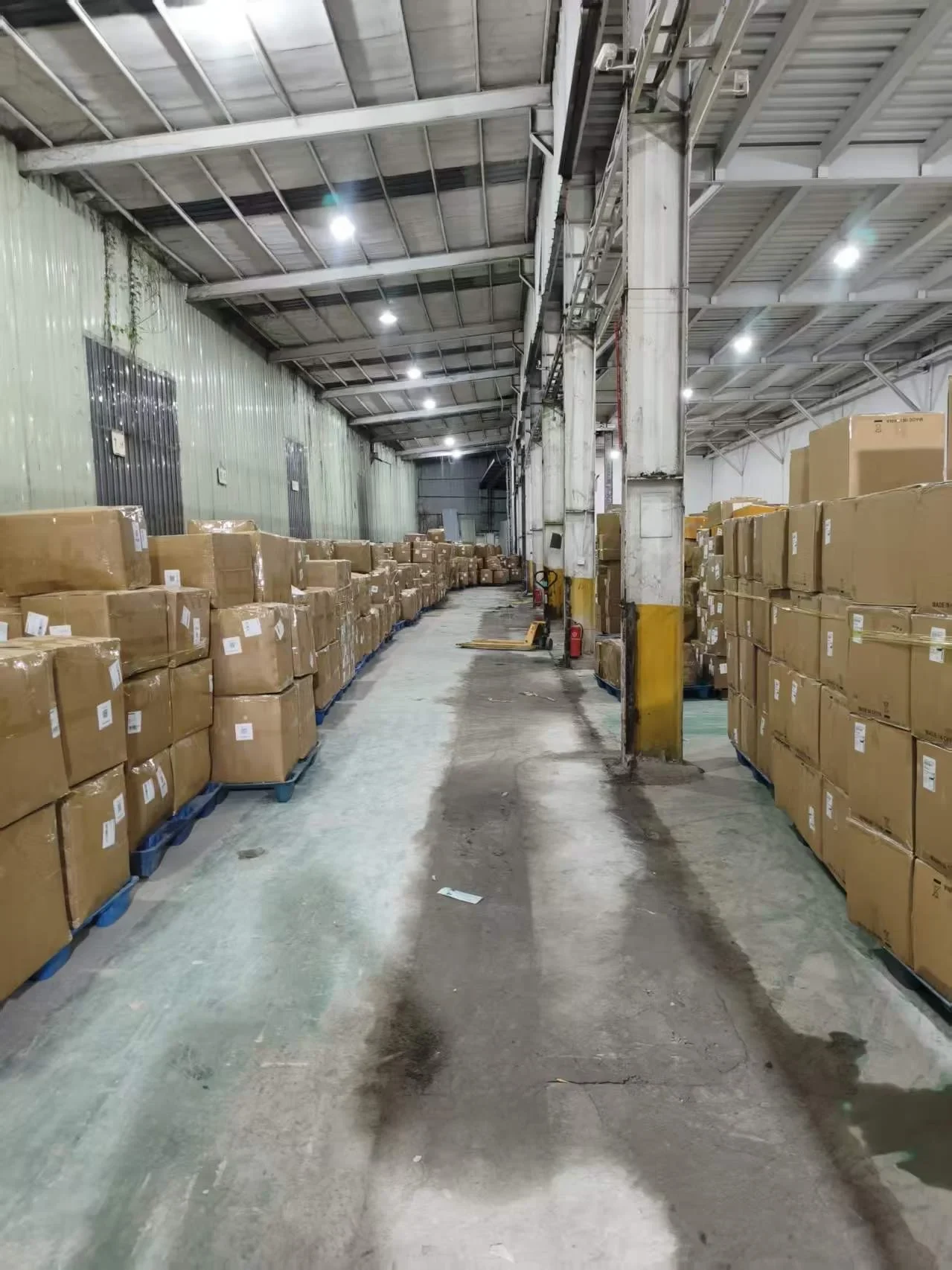
The commercial invoice is required for export and import clearance and is used by customs officials in the buyer’s country to assess duties and taxes. Destination-specific requirements should be checked before completing it. That makes an invoice review more useful than simply confirming that a PDF exists. [3]
An HS code may appear on the commercial invoice and may assist clearance. However, the available guidance does not establish the correct classification for any particular product. Recommended practice is to give the reviewer enough detail to test the proposed code; a code copied from an earlier shipment is not, by itself, an explanation. [1][3]
Keep Customs Release Separate From Terminal Release
Use two separate status questions in your shipment tracker: “Has customs release been confirmed?” and “Has the cargo facility confirmed release or availability for collection?” This is an operational recommendation, not a claim that the cited references describe terminal procedures. Those procedures must be checked with the responsible carrier, forwarder, or facility. [1][2]
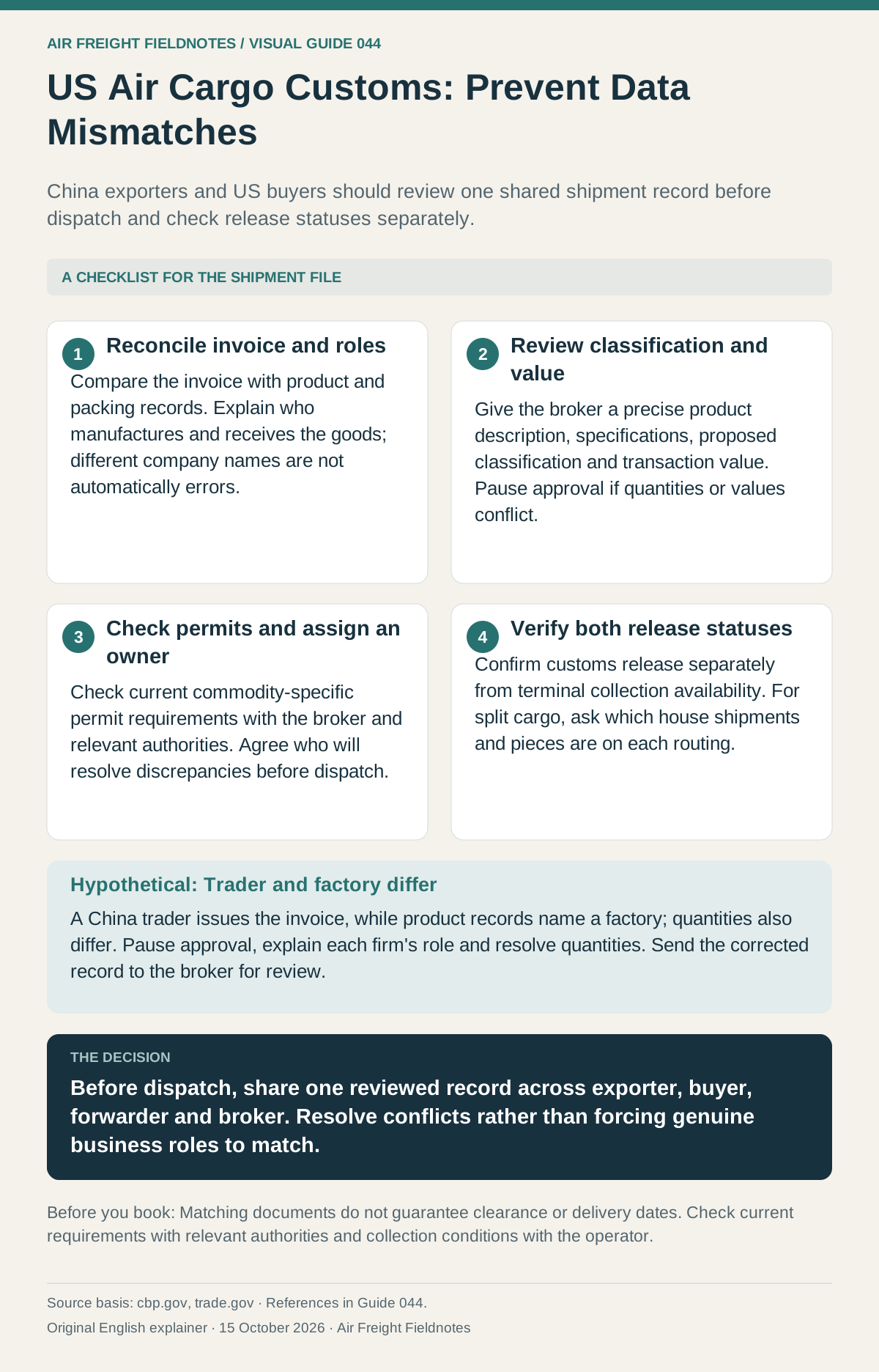
Read the infographic as text
China exporters and US buyers should review one shared shipment record before dispatch and check release statuses separately.
- 1. Reconcile invoice and roles Compare the invoice with product and packing records. Explain who manufactures and receives the goods; different company names are not automatically errors.
- 2. Review classification and value Give the broker a precise product description, specifications, proposed classification and transaction value. Pause approval if quantities or values conflict.
- 3. Check permits and assign an owner Check current commodity-specific permit requirements with the broker and relevant authorities. Agree who will resolve discrepancies before dispatch.
- 4. Verify both release statuses Confirm customs release separately from terminal collection availability. For split cargo, ask which house shipments and pieces are on each routing.
Hypothetical: Trader and factory differ A China trader issues the invoice, while product records name a factory; quantities also differ. Pause approval, explain each firm's role and resolve quantities. Send the corrected record to the broker for review.
Decision: Before dispatch, share one reviewed record across exporter, buyer, forwarder and broker. Resolve conflicts rather than forcing genuine business roles to match.
Matching documents do not guarantee clearance or delivery dates. Check current requirements with relevant authorities and collection conditions with the operator.
The reason for separating the questions is practical: customs reporting and physical shipment routing are different subjects. CBP’s air-manifest guidance addresses additional reporting when a consolidated shipment travels on more than one aircraft. An inference for shipment tracking is that a single overall reference should not replace checking the status of the relevant house shipment and its actual routing. [2]
Ask for explicit status descriptions rather than accepting “released” without context. Record who confirmed customs status, who confirmed collection availability, and whether the confirmation covers all pieces. This recommended control helps avoid treating a document milestone or partial-shipment update as proof that the entire consignment can be collected. [1][2]
Use a Pre-Dispatch Checklist and a Clear Exception Process
Apply the following checklist before dispatch where possible. It translates the sources’ preparation and documentation principles into a working process; it does not replace commodity-specific advice or establish a guaranteed clearance outcome. [1][3]
- Write a precise description covering what the product is, its materials, and its intended function.
- Confirm the manufacturer, seller, buyer, and consignee, recording any different names or addresses.
- Check invoice quantities and value against the transaction records.
- Send specifications and supporting product information for classification review.
- Ask whether other agencies’ requirements or permits apply.
- Identify who approves corrections and who sends the revised information onward.
- For split cargo, ask how each affected house shipment will be tracked.
- Arrange separate confirmation of customs status and terminal collection availability.

This workflow assumes the parties can obtain reliable product and transaction details. It can fail if the exporter supplies incomplete specifications, a revised invoice is not shared, or a product-specific requirement is discovered late. If a discrepancy appears, identify the affected field, obtain supporting evidence, and coordinate the correction rather than changing one document in isolation. This is recommended practice inferred from the sources. [1][2][3]
Hypothetical worked decision example: A US buyer orders components from a Chinese trading company. The invoice names the trader, but product records name a separate factory. The buyer also finds that the invoice quantity differs from the packing information. These invented details illustrate a review problem; they do not describe an actual shipment. [1][3]
In this hypothetical case, the decision is to pause document approval, not automatically replace the trader’s name with the factory’s. The exporter explains each business’s role and resolves the quantity difference. The buyer sends the corrected record and specifications for review. This addresses the uncertainty without assuming that different company names necessarily indicate an error. [1][3]
Frequently Asked Questions
Does a matching invoice guarantee customs clearance?
No. Invoice consistency is only part of preparation. CBP advises checking commodity-specific entry requirements, including those of other federal agencies. A complete-looking invoice does not establish that every applicable requirement has been satisfied. [1][3]
Should the manufacturer and consignee always have the same name?
Do not use name matching as the test. As a recommended review method, establish who makes the goods and who receives them, then confirm the information needed for the transaction. The cited references do not establish a universal manufacturer-and-consignee naming rule. [1][3]
What should we check when a consolidation is split?
Ask which house shipments and pieces are on each routing, and seek specific status updates. CBP describes additional reporting for split consolidated air shipments. Separately confirming collection availability is a recommended operational step; the supplied guidance does not establish terminal-release procedures. [2]
Sources and further reading
- Tips for New Importers and Exporters | U.S. Customs and Border ProtectionPrimary source · Retrieved 15 October 2026
- AMS Air Features | U.S. Customs and Border ProtectionPrimary source · Retrieved 15 October 2026
- Commercial InvoicePrimary source · Retrieved 15 October 2026
Field research
- Reddit field research 1Topic discovery and anecdotal context; not evidence of a general rule.
- Reddit field research 2Topic discovery and anecdotal context; not evidence of a general rule.
Prepared from the linked primary references and public field research. Field photographs illustrate general handling; worked examples use separate hypothetical figures. Acceptance, charges and destination requirements should be checked against the specific shipment and current operator or authority instructions.