 Skip to content

For import VAT on air freight, start with the customs value, then identify duties and relevant additional costs without counting anything twice. Verify the shipment’s destination before finalising transport adjustments. Keep the tax payable calculation separate from any recovery assessment: paying import VAT does not, by itself, establish recovery eligibility. [1][2]
Start with customs value, not the supplier’s invoice alone
This guide focuses on China-to-UK shipments because the supplied valuation evidence is UK guidance. It supports a worksheet method, not a universal calculation for every importing country. The recovery distinction above is a verification safeguard: the cited references explain valuation, but do not establish whether a particular buyer can recover VAT. [1][2]
UK import VAT valuation starts with the customs value used for duty purposes. That starting point still applies when no customs duty is payable. A zero duty amount therefore does not mean the customs value can be skipped, or that the invoice total automatically becomes the complete VAT base. [1]

Keep three figures separate: the commercial invoice amount, the established customs value, and the final import VAT value. HMRC’s guidance says information establishing customs value should not be treated as establishing the full value for VAT purposes. Duties, levies and relevant additional costs can affect the VAT calculation. [2]
As a practical recommendation, give each worksheet entry a document reference and an “already included?” field. This makes it easier to explain why a charge was added, excluded or held for review. It also helps prevent the same transport cost appearing inside both the starting value and a later adjustment. [1][2]
Compare freight charges by treatment, not just by price
For an air shipment, do not treat every charge labelled “freight” as one interchangeable amount. The supplied UK guidance requires relevant transport costs to be considered, including transport to a further UK destination known when the goods are imported. It also addresses costs connected with a known destination beyond the UK. Verify the actual route before deciding what belongs in the VAT base. [1][2]
| Worksheet item | What to verify | Treatment or decision |
|---|---|---|
| Customs value | The established amount and its supporting calculation | Use as the VAT valuation starting point, even if duty is zero. [1] |
| China-to-UK air transport | Which amounts are already reflected in the starting value | Reconcile before making additional freight adjustments. This is a worksheet inference. [1][2] |
| Delivery to a further UK destination | Whether that destination was known at import | Include the resulting transport costs as required by the guidance. [1] |
| Transport beyond the UK | Whether the further destination was known at import | Review the associated transport costs for inclusion under the UK guidance. [2] |
| Qualifying zero-rated import services | Whether the service meets the stated connection with importation | Include the service cost in the import VAT value. [1] |
| Duties, levies and additional costs | Amounts declared and whether costs are already included elsewhere | Account for them in the VAT calculation without duplicating entries. [2] |
A service invoice showing zero-rated VAT does not necessarily mean its cost disappears from the import VAT base. The supplied guidance specifically includes qualifying services connected with importation. Check the service’s treatment rather than interpreting the invoice’s VAT line as a valuation instruction. [1]
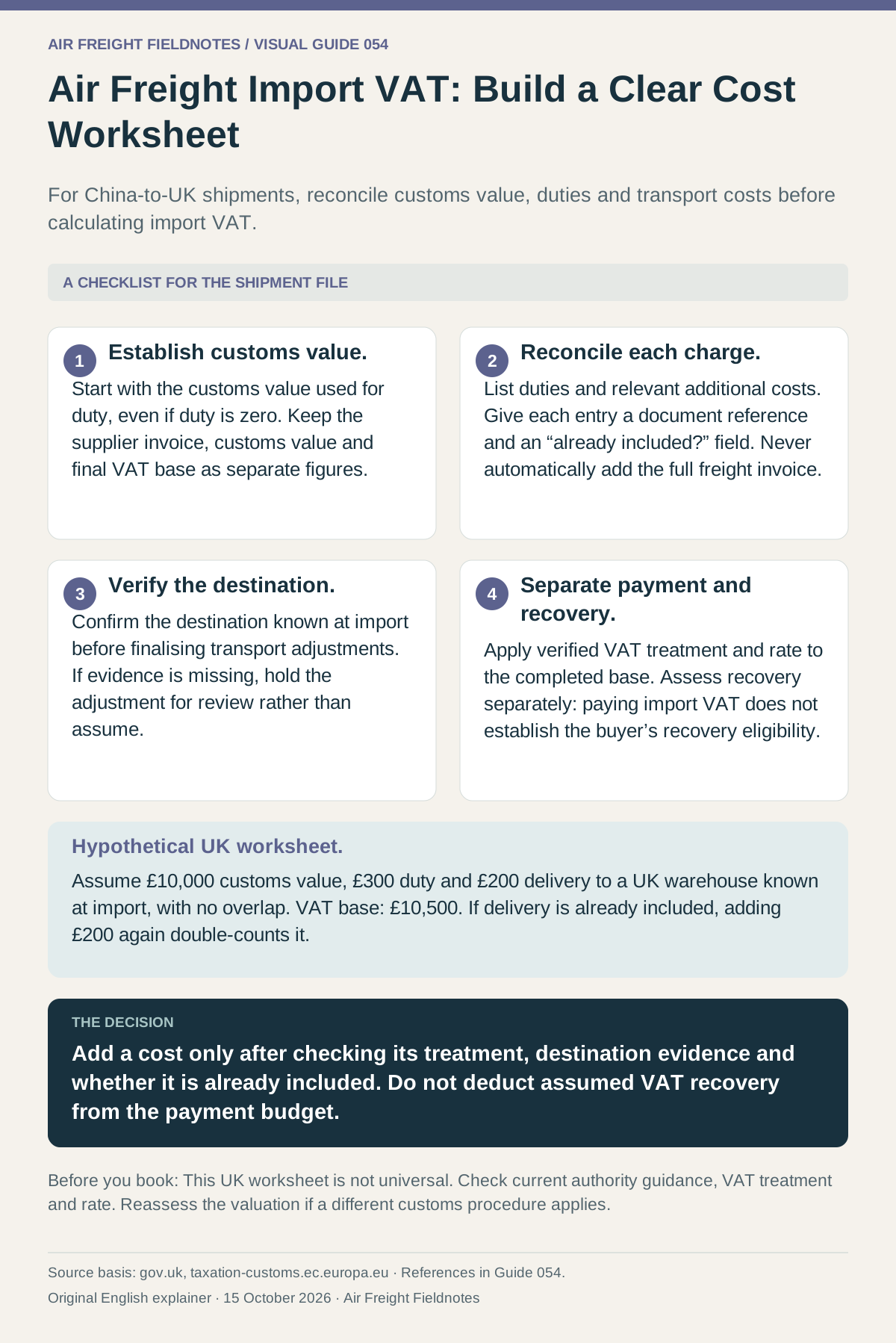
Read the infographic as text
For China-to-UK shipments, reconcile customs value, duties and transport costs before calculating import VAT.
- 1. Establish customs value. Start with the customs value used for duty, even if duty is zero. Keep the supplier invoice, customs value and final VAT base as separate figures.
- 2. Reconcile each charge. List duties and relevant additional costs. Give each entry a document reference and an “already included?” field. Never automatically add the full freight invoice.
- 3. Verify the destination. Confirm the destination known at import before finalising transport adjustments. If evidence is missing, hold the adjustment for review rather than assume.
- 4. Separate payment and recovery. Apply verified VAT treatment and rate to the completed base. Assess recovery separately: paying import VAT does not establish the buyer’s recovery eligibility.
Hypothetical UK worksheet. Assume £10,000 customs value, £300 duty and £200 delivery to a UK warehouse known at import, with no overlap. VAT base: £10,500. If delivery is already included, adding £200 again double-counts it.
Decision: Add a cost only after checking its treatment, destination evidence and whether it is already included. Do not deduct assumed VAT recovery from the payment budget.
This UK worksheet is not universal. Check current authority guidance, VAT treatment and rate. Reassess the valuation if a different customs procedure applies.
Use a checklist before approving the declaration
The following checklist is a practical control method inferred from the valuation guidance. Complete it while the invoice, transport breakdown and destination information can still be reconciled, rather than relying on a single all-in shipping total. [1][2]
- Confirm the jurisdiction: this worksheet uses UK valuation evidence; do not export its conclusions unchanged to another country. [1][2]
- Record the customs value: attach its calculation and note which transport amounts it already contains. [1][2]
- Verify the destination: record the destination known at import and the evidence supporting it. [1][2]
- Split transport charges: distinguish the air movement from onward transport so each amount can be reviewed. This is a worksheet inference. [1][2]
- Reconcile additions: identify applicable duties, levies and additional costs, marking anything already counted. [2]
- Resolve missing costs: HMRC’s supplied guidance addresses declaring required additional costs not included in the invoice or other value elements. Confirm the applicable declaration fields before submission. [2]
- Separate payment from recovery: leave recovery as “not assessed” until separately verified; these sources do not establish entitlement. [1][2]
A separate failure case is confusing physical arrival with the place of customs clearance. EU customs transit can temporarily suspend import duties and taxes and allow clearance at destination rather than the entry point. If a proposed route uses transit, verify the procedure before applying an ordinary UK import worksheet. This is a routing caution, not an exemption claim. [3]
Hypothetical example: decide whether onward freight is missing
Hypothetical example: a China exporter ships goods by air to a UK buyer. Assume the customs value has already been correctly established at £10,000, with all relevant adjustments within that starting value completed. Assume assessed duty is £300. A separate £200 delivery charge to the buyer’s UK warehouse is not included in either amount, and that destination was known at import. These figures are invented solely to illustrate the valuation method. [1][2]
On those assumptions, the worksheet produces a VAT base of £10,000 + £300 + £200 = £10,500. The next step is to apply the independently verified VAT treatment and rate. No rate or tax amount is assumed here. Whether any resulting VAT can be recovered remains a separate question not answered by these valuation sources. [1][2]

The decision changes if the £200 was already included: adding it again would duplicate the cost. If the destination evidence is missing, the worksheet cannot safely rely on the example’s assumption. If the shipment uses a different customs procedure, reassess that procedure first. These are practical failure checks inferred from the valuation and transit guidance. [1][2][3]
FAQs about import VAT air freight worksheets
Does no customs duty mean no import VAT valuation is needed?
No. UK guidance requires the import VAT valuation to start from customs value even when no duty is payable. Relevant additional costs still need review. [1][2]
Should I automatically add the whole freight invoice?
No. Reconcile what is already included, identify relevant services and verify the known destination. Adding an undivided freight total risks counting costs twice; that risk is a practical recommendation from the valuation structure. [1][2]
Does this worksheet prove that the buyer can recover VAT?
No. It organises the valuation calculation. The supplied guidance does not establish a buyer’s recovery eligibility, so record recovery as a separate unresolved assessment rather than deducting assumed recovery from the payment budget. [1][2]
Sources and further reading
- Working out the VAT value using the customs value of the imported goods - GOV.UKPrimary source · Retrieved 15 October 2026
- How to value goods for import VAT - GOV.UKPrimary source · Retrieved 15 October 2026
- Customs transit - Taxation and Customs Union - European CommissionPrimary source · Retrieved 15 October 2026
Field research
- Reddit field research 1Topic discovery and anecdotal context; not evidence of a general rule.
- Xiaohongshu field research 2Topic discovery and anecdotal context; not evidence of a general rule.
Prepared from the linked primary references and public field research. Field photographs illustrate general handling; worked examples use separate hypothetical figures. Acceptance, charges and destination requirements should be checked against the specific shipment and current operator or authority instructions.