 Skip to content
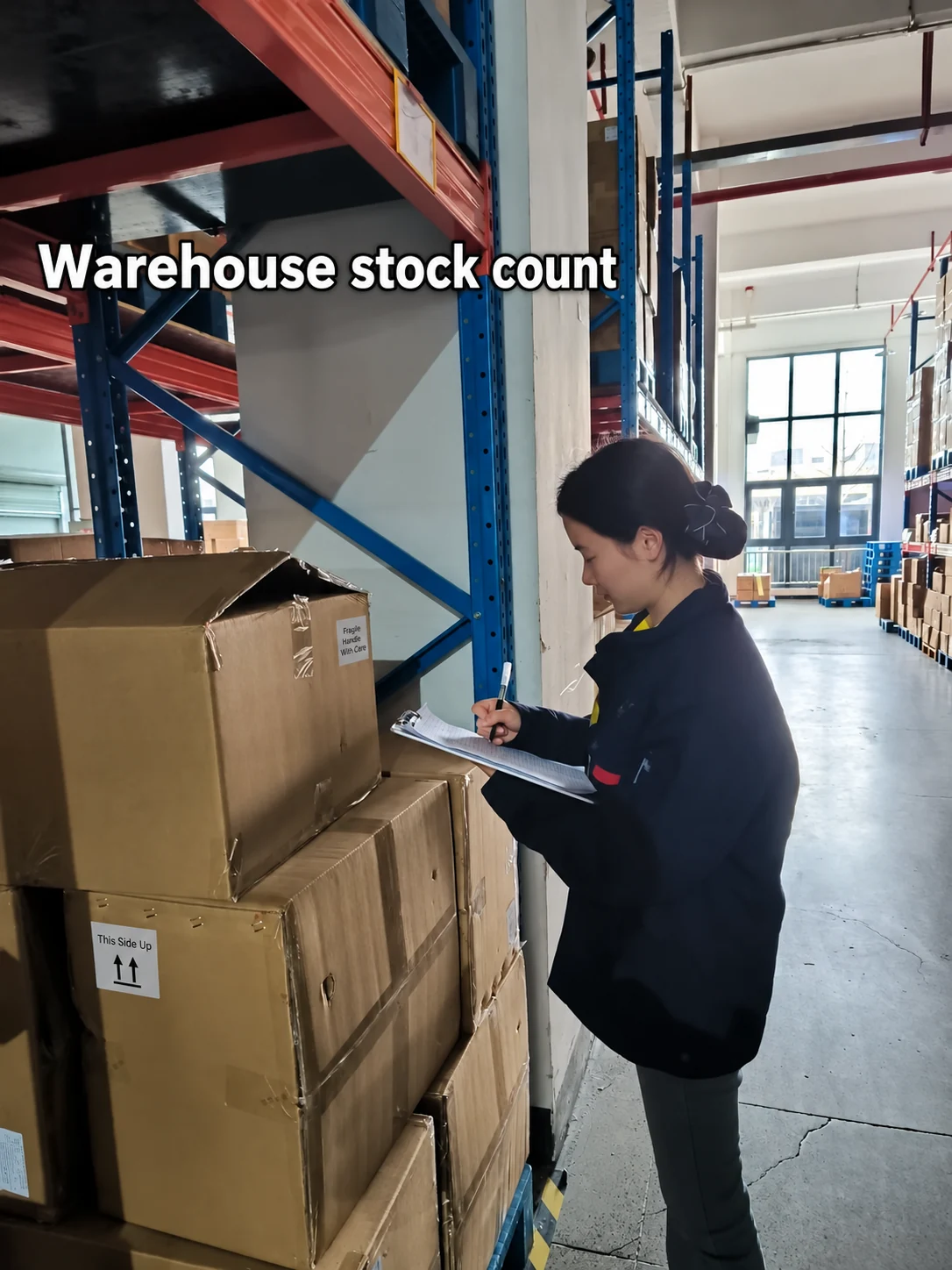
Prepare air freight documents by confirming destination requirements, agreeing who supplies each record, and checking that shipment data match across files. Start with the commercial invoice, then verify packing details, transport records, customs filings, and any product-specific certificates. Resolve missing information before handover; requirements depend on the goods and destination. [1][2][3]
Build a shipment-specific document list first
Start with the overseas customer or importer and the freight forwarder. Ask what the destination requires for this product and shipment, rather than reusing an old document pack without checking it. The supplied export-document guidance recommends those contacts as starting points and warns that some products or shipments need special documents. [1]
Use the comparison below as a preparation framework, not a universal legal checklist. The cited references directly discuss invoices, air waybill digitization, and possible special documents; they do not establish destination-specific rules for packing lists, customs declarations, or individual certificates. Those gaps need confirmation before shipment. [1][2][3]
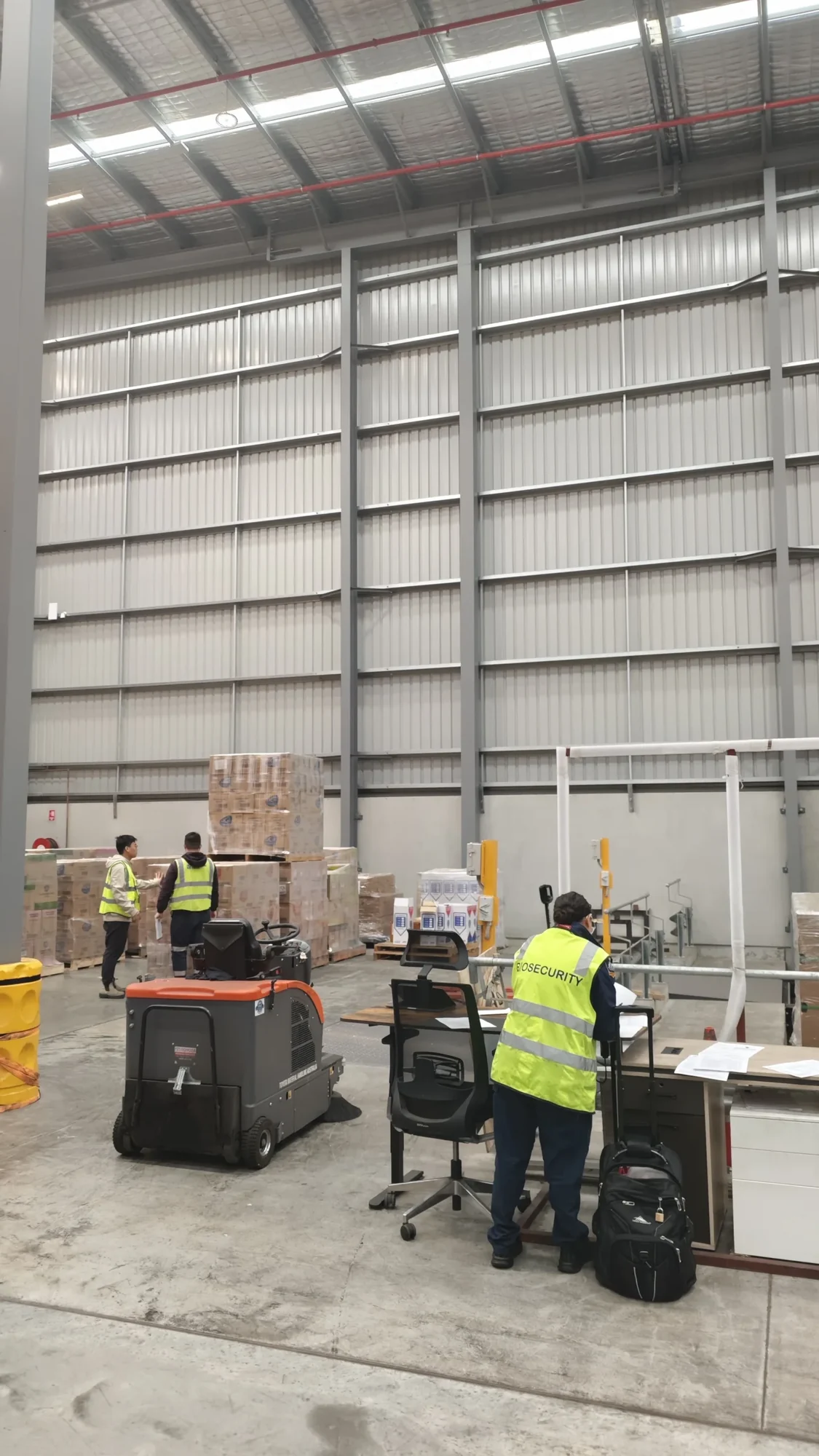
| Document or record | Purpose to distinguish | Preparation check |
|---|---|---|
| Commercial invoice | Commercial information used for export and import clearance and duty assessment. | Confirm destination requirements and reconcile the final goods, price, and quantity details. [2] |
| Packing list | A separate packing-detail record to request and confirm; not a substitute for the invoice. | As a practical cross-check, reconcile cartons, contents, weights, and dimensions with the actual shipment. Confirm the required format locally. [1] |
| Air waybill (AWB) | The air transport document; electronic implementation involves agreed processes and locations. | Confirm the transport-data workflow and whether electronic handling is supported for the shipment. [3] |
| Export/import declarations | Customs filings to confirm separately from the supporting commercial documents. | Ask the relevant filing party which declarations, data, permissions, and acknowledgments are needed. The cited references do not specify these procedures. [1][2] |
| Commodity-dependent certificates | Additional evidence that may be required for particular goods or shipments. | Confirm the exact document, issuer, and acceptance conditions instead of assuming every shipment needs the same certificates. [1] |
Keep commercial, packing, and transport data consistent
The commercial invoice is required for export and import clearance, and destination customs officials use it to assess duties and taxes. Destination requirements can differ: the supplied guidance notes that some countries require a particular form, while many accept the seller’s version if it contains the necessary information. [2]
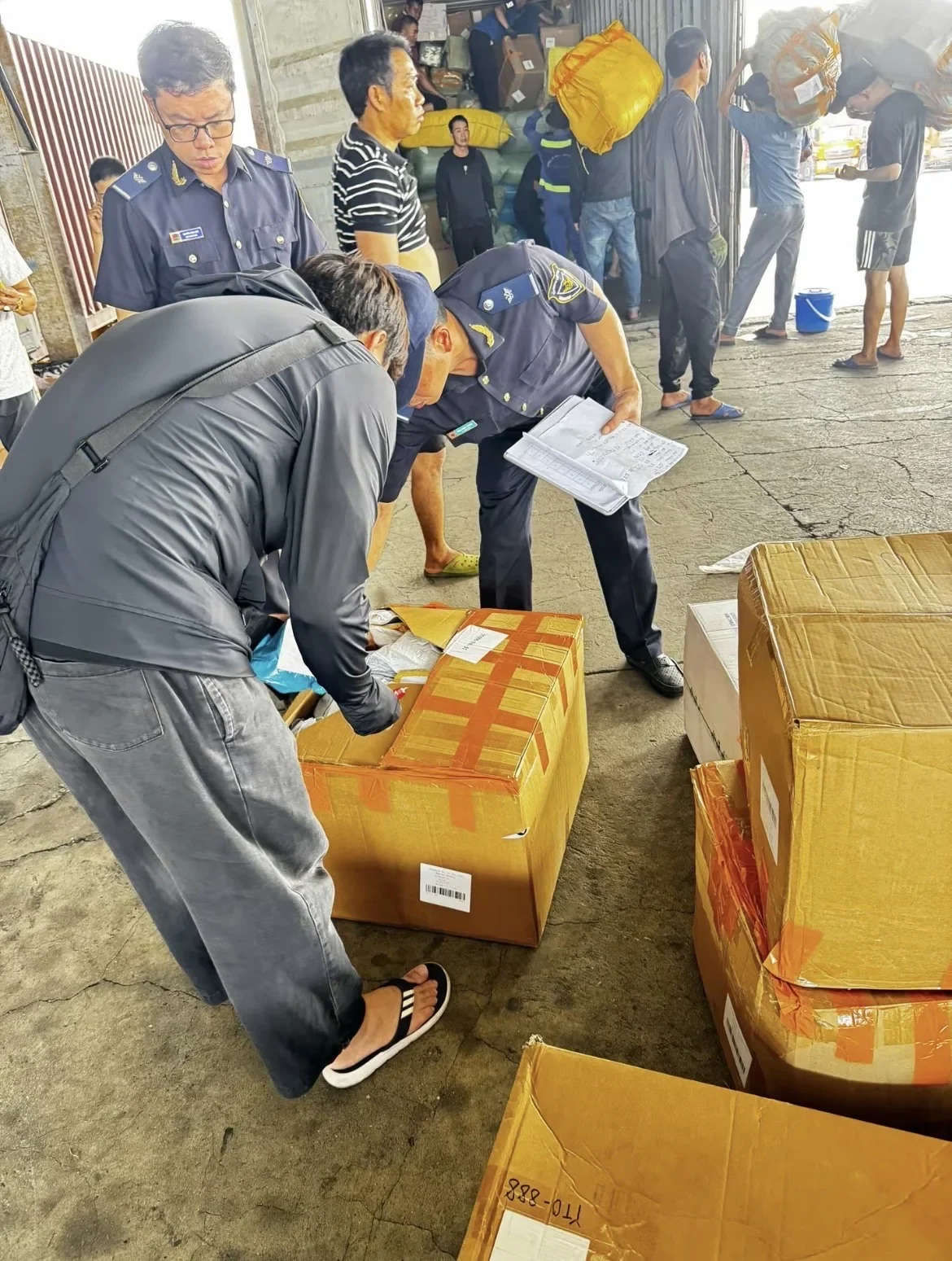
Do not confuse the pro forma invoice with the final commercial invoice. The pro forma supports the quotation and negotiation stage. A practical recommendation is to check that the final invoice reflects the agreed shipment rather than leaving preliminary quantities or prices unchanged. [1][2]
Create one controlled shipment-data sheet for everyone preparing documents. As a practical recommendation from the sources’ emphasis on correct information and electronic data quality, record party names, product descriptions, quantities, values, currency, package details, and applicable classification information there. Assign someone to approve changes and distribute the current version. [1][2][3]
Consistency does not mean every field must be identical. As a practical checking example, a product’s unit quantity and its carton count describe different things. Reconcile the relationship between them instead of copying one number everywhere. Where descriptions differ between records, ask whether they still identify the same goods clearly. This is a proposed review method, not a prescribed document format. [1][2]
An HS code may appear on the commercial invoice and may help clearance, but it should not be treated as a complete answer to the document question. The guidance separately recognizes shipment-specific documents. The practical recommendation is to verify requirements using the product details and destination, not the classification code alone. [1][2]
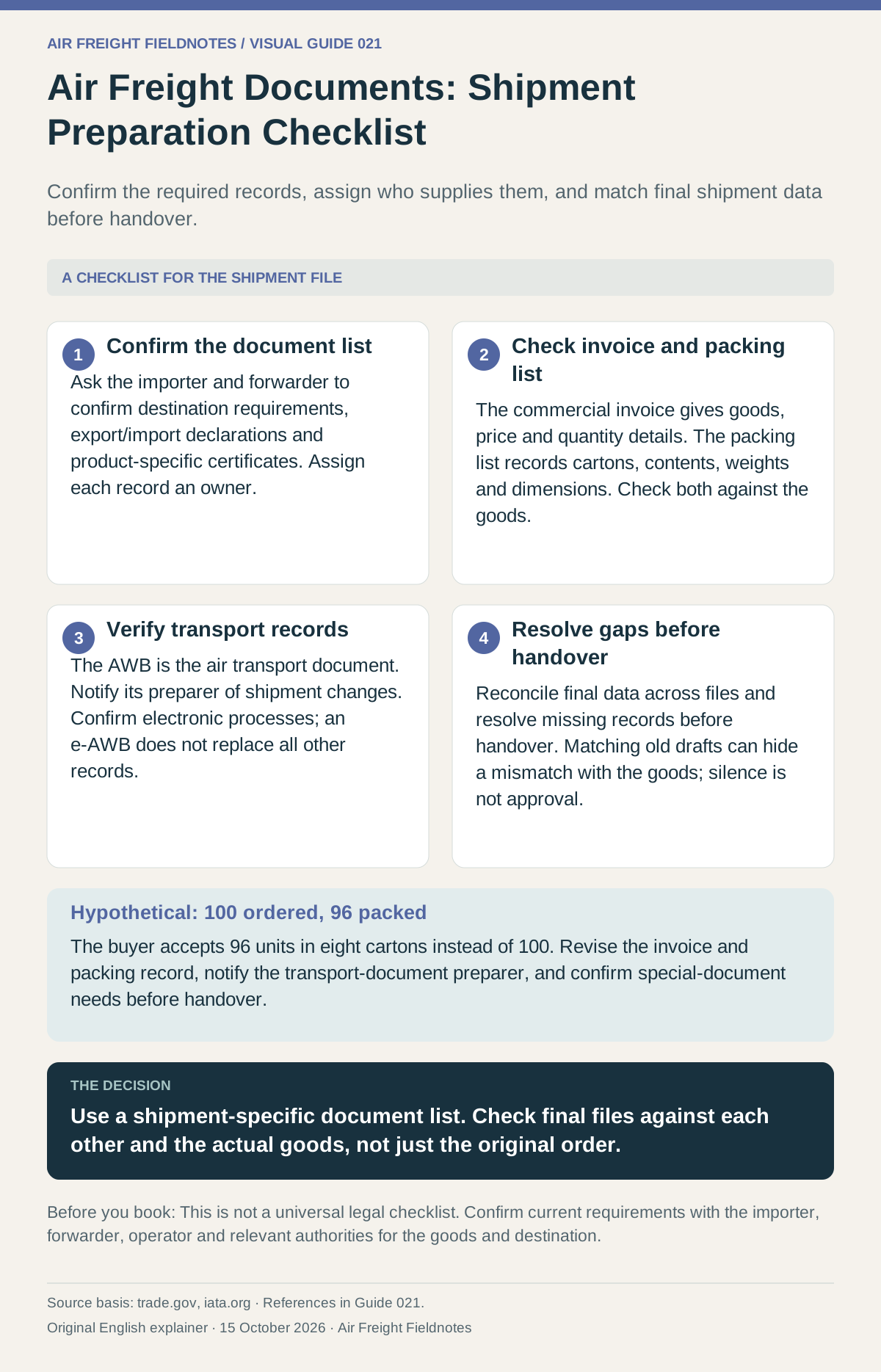
Read the infographic as text
Confirm the required records, assign who supplies them, and match final shipment data before handover.
- 1. Confirm the document list Ask the importer and forwarder to confirm destination requirements, export/import declarations and product-specific certificates. Assign each record an owner.
- 2. Check invoice and packing list The commercial invoice gives goods, price and quantity details. The packing list records cartons, contents, weights and dimensions. Check both against the goods.
- 3. Verify transport records The AWB is the air transport document. Notify its preparer of shipment changes. Confirm electronic processes; an e-AWB does not replace all other records.
- 4. Resolve gaps before handover Reconcile final data across files and resolve missing records before handover. Matching old drafts can hide a mismatch with the goods; silence is not approval.
Hypothetical: 100 ordered, 96 packed The buyer accepts 96 units in eight cartons instead of 100. Revise the invoice and packing record, notify the transport-document preparer, and confirm special-document needs before handover.
Decision: Use a shipment-specific document list. Check final files against each other and the actual goods, not just the original order.
This is not a universal legal checklist. Confirm current requirements with the importer, forwarder, operator and relevant authorities for the goods and destination.
Confirm filings, certificates, and the electronic workflow
Ask separate questions about export clearance in China and import clearance at destination. Who will prepare each filing? Who will supply missing information? Who will review the submitted data? This responsibility check is a recommended workflow inferred from the guidance to consult the importer and forwarder; the supplied material does not establish Chinese or destination filing procedures. [1][2]
For commodity-dependent paperwork, send the reviewing party a precise product description and relevant specifications. Ask them to identify any required certificate or permit and explain how to verify its acceptance. Do not infer a requirement from another shipment’s experience: the source supports checking for special documents, not any particular commodity rule. [1]
Electronic air freight documents still need coordination. IATA’s material describes digitizing the AWB and other cargo documents, with attention to business processes, electronic communication, data quality, and agreed locations. A practical recommendation is to confirm the participating parties’ workflow rather than assume that sending a PDF completes an e-AWB process. [3]
Use a release checklist and test the weak points
This checklist is a practical synthesis of the supplied guidance, not a declaration that every listed record is legally mandatory for every shipment. Its purpose is to expose unresolved requirements and inconsistent data before handover. [1][2][3]
- Obtain the importer’s and forwarder’s shipment-specific document requirements.
- Confirm who prepares, reviews, and corrects each record.
- Check the commercial invoice against the final sale and destination requirements.
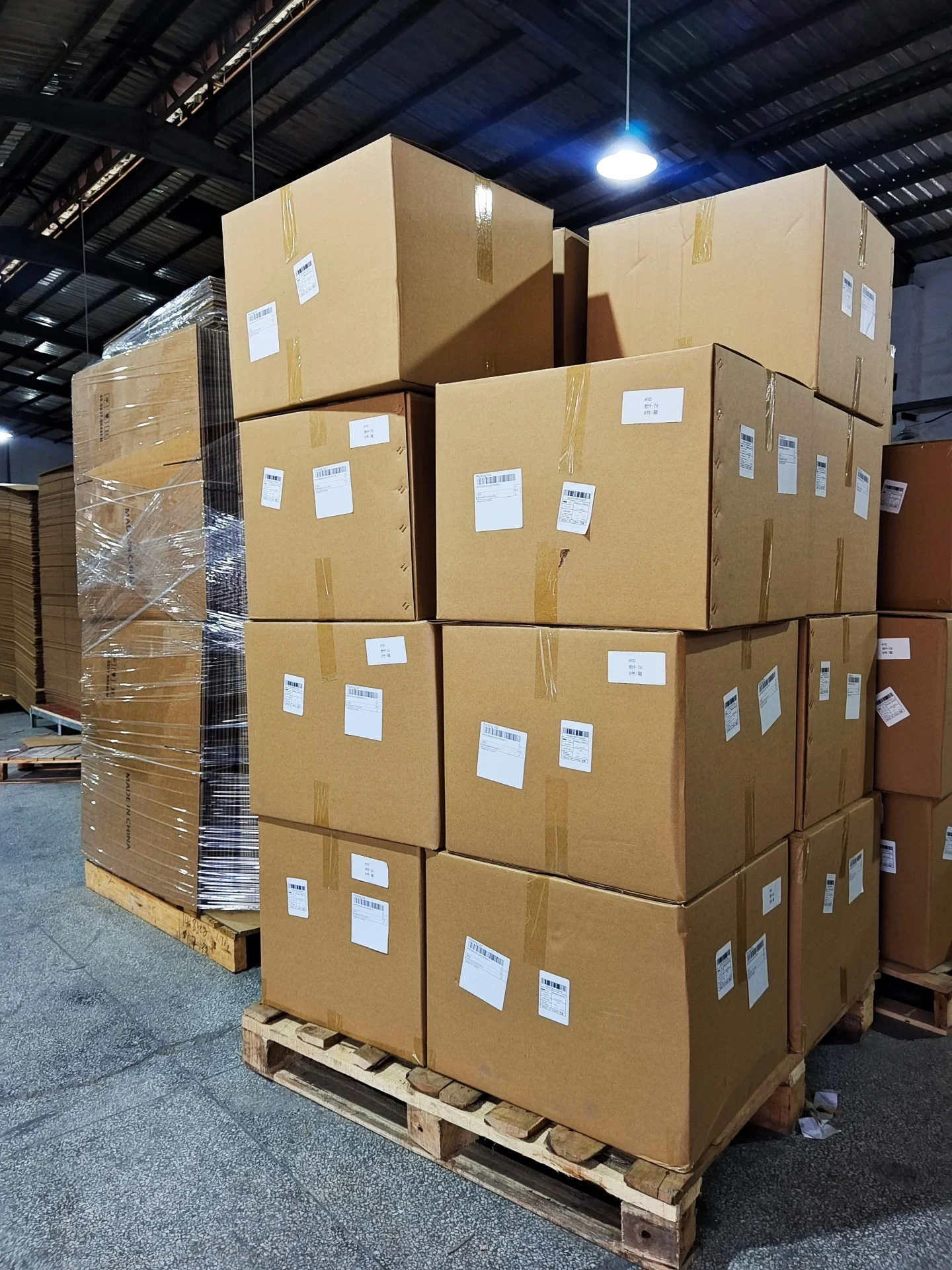
- Reconcile packing details with the goods actually prepared.
- Confirm the AWB data and electronic-document workflow.
- Verify export and import filing responsibilities separately.
- Resolve whether commodity-dependent certificates or permits are needed.
- Distribute the approved document version and withdraw superseded drafts.
Hypothetical worked decision example: A China exporter prepares an order described on the draft invoice as 100 units. The warehouse reports 96 units packed in eight cartons. Assume the buyer accepts the reduced quantity and no additional product document has yet been confirmed. The proposed decision is to revise the invoice and packing record, notify the transport-document preparer, and obtain confirmation of any special-document requirements before handover. This example illustrates a checking method, not a clearance outcome. [1][2][3]
The method fails if the team compares only old drafts or assumes silence means approval. In the hypothetical example, matching every document to the original 100-unit order would produce agreement between files but not agreement with the goods. The practical lesson is to check both document consistency and physical shipment accuracy. [1][2]
Frequently asked questions about air freight documents
Can a pro forma invoice replace the commercial invoice?
Do not assume so. The supplied guidance distinguishes the quotation-stage pro forma from the commercial invoice required for export and import clearance. Confirm the destination’s invoice requirements before finalizing the shipment pack. [1][2]
Does using an e-AWB remove all other paperwork?
No such conclusion is supported. IATA describes AWB digitization alongside work on commercial and special cargo documents. Confirm which records can be handled electronically and which additional documents the shipment needs. [1][3]
How do I find out which certificates my product needs?
Start with the importer and freight forwarder, providing accurate product and shipment details. Ask for destination-specific confirmation. The cited references establish that special documents may be needed, but they do not identify the certificates required for a particular product. [1][2]
Sources and further reading
- Common Export DocumentsPrimary source · Retrieved 15 October 2026
- Commercial InvoicePrimary source · Retrieved 15 October 2026
- IATA - efreight / eAWBPrimary source · Retrieved 15 October 2026
Field research
- Reddit field research 1Topic discovery and anecdotal context; not evidence of a general rule.
- Reddit field research 2Topic discovery and anecdotal context; not evidence of a general rule.
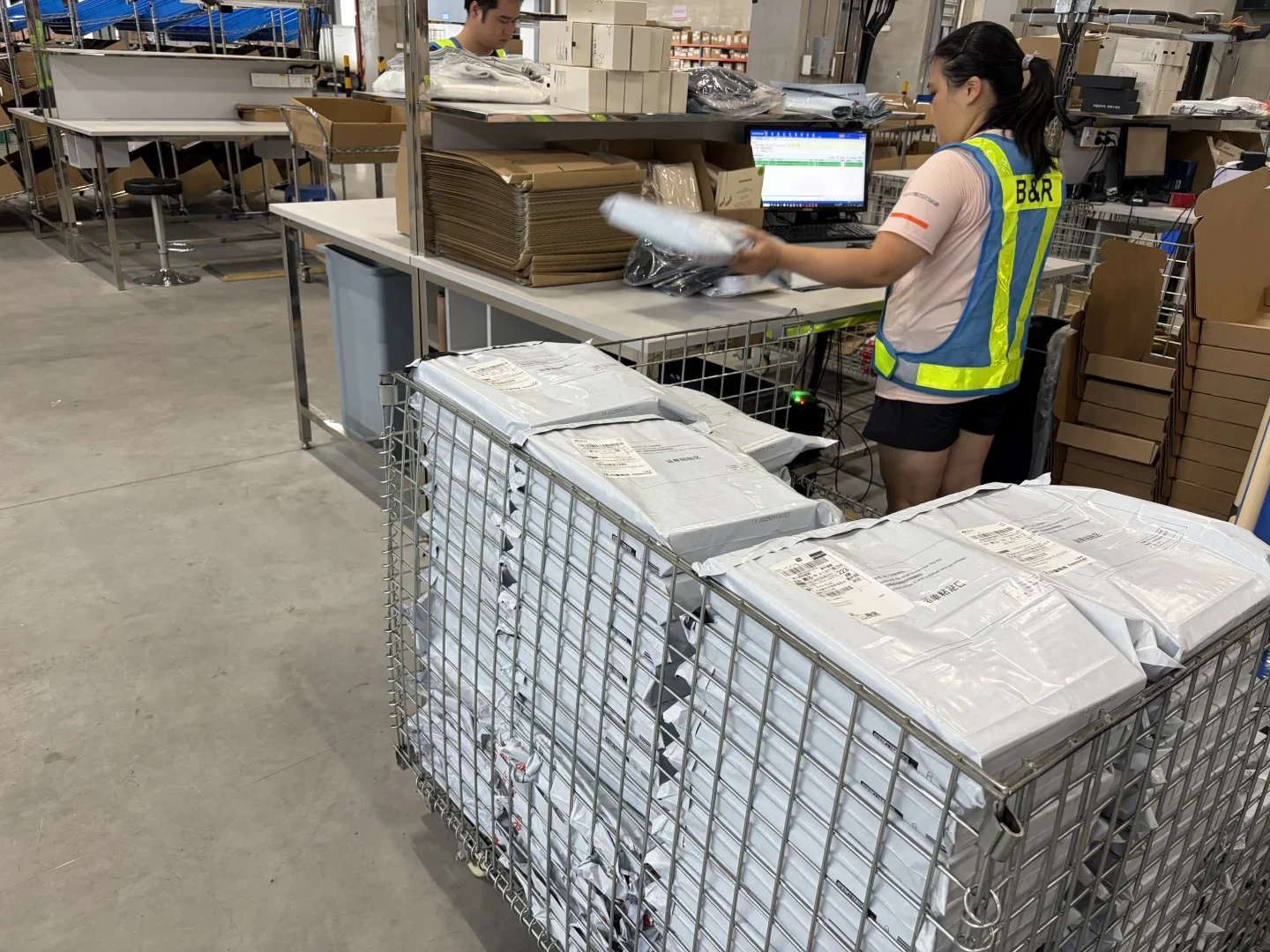
Prepared from the linked primary references and public field research. Field photographs illustrate general handling; worked examples use separate hypothetical figures. Acceptance, charges and destination requirements should be checked against the specific shipment and current operator or authority instructions.