 Skip to content

For EORI air freight, identify who will import and who will declare the goods before booking. EU and UK customs identification must be checked separately. Confirm the relevant official registration, entity details and clearance arrangements; do not assume one number, format or courier appointment covers every shipment or customs territory. [1][3]
What an EORI number does—and what it does not resolve
An Economic Operators Registration and Identification number identifies economic operators and other persons for customs purposes. The European Commission states that EORI is mandatory for customs operations in the EU customs territory, including import, export and transit. Economic operators must communicate their number to the relevant customs authorities. [1]
The EU source also states that a person can hold only one valid EORI number at a time. Read that statement within its EU context: it does not establish that an EU registration covers UK customs activity. The UK has separate official guidance explaining who may need an EORI. [1][3]
For shipment planning, separate three questions: which business is importing, which party will submit the declaration, and which identification each party needs for its role. This is a practical recommendation from EORI’s identification function—not a complete statement of representation law. Ask the appointed customs professional to confirm the arrangement for the actual movement. [1][3]
An EORI check alone cannot establish whether a product is admissible, whether its description is correct, or whether all supporting documents are ready. That is an inference from the limited purpose described in the cited references: identification is one clearance input, not proof that every clearance condition has been met. [1][3]
EU versus UK: compare the customs context, not just the number
Start with the customs territory involved, rather than the buyer’s postal address or the aircraft’s destination alone. The EU source expressly covers import, export and transit. The supplied UK guidance refers to several activities, including using customs systems and certain carrier functions, so the registration question is not limited to the purchaser. [1][3]
| Planning point | EU customs context | UK / Great Britain planning context |
|---|---|---|
| Official starting point | European Commission EORI guidance describes the common EU identification system. [1] | GOV.UK guidance explains who may need an EORI. [3] |
| Scope supported by the evidence | Customs operations include import, export and transit. [1] | The cited guidance mentions customs-system users and certain carrier activities, but is incomplete. [3] |
| Registration assumption to avoid | Do not treat an EU identification number as evidence of UK registration. This is a planning inference. [1][3] | Do not assume an EU registration answers the requirements for a Great Britain shipment. Confirm the applicable UK guidance. [1][3] |
| Pre-shipment action | Confirm the relevant entity’s official registration and the number to communicate for customs operations. [1] | Confirm who needs registration for the actual UK movement and customs role. [3] |
Do not apply a universal EORI format test. These cited guidances do not provide a complete format specification for every relevant jurisdiction. A sensible-looking number is therefore not sufficient evidence of the correct registration. Use the applicable official registration or checking route and retain the confirmation. This is a recommended verification control. [1][3]
“UK” should not replace a precise routing discussion. For a Great Britain delivery, state that destination explicitly when requesting advice. If the movement involves another customs context, ask which official guidance applies rather than extending a Great Britain answer by assumption. The supplied UK extract is too limited to settle every territorial case. [3]
Assign importer and declarant responsibilities before booking
Build a short responsibility record naming the Chinese exporter, intended importer, party submitting the declaration, and transport provider. For each, record its legal name, task and registration information where applicable. This is an operational recommendation based on the sources’ focus on identifying persons and their customs activities. [1][3]
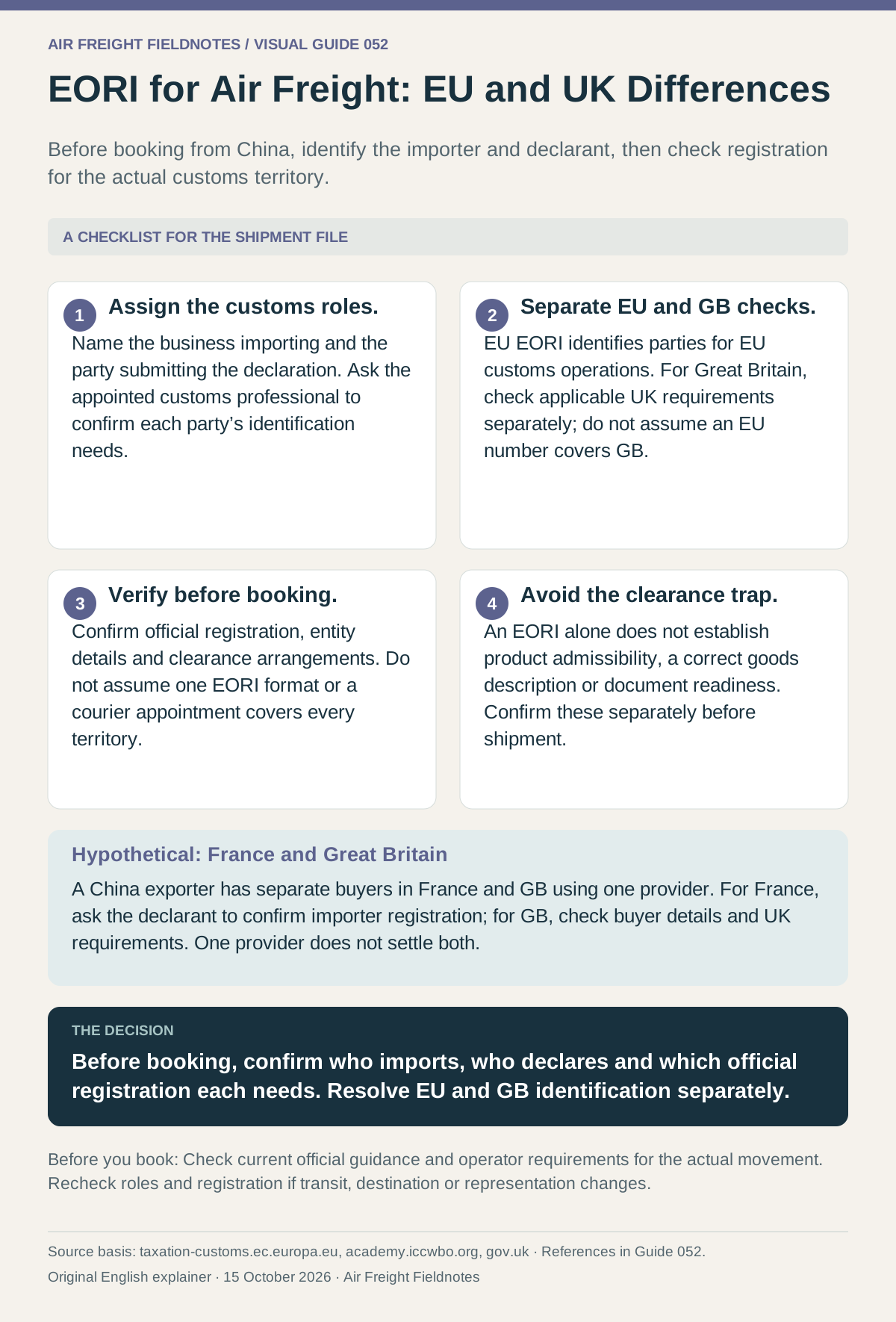
Read the infographic as text
Before booking from China, identify the importer and declarant, then check registration for the actual customs territory.
- 1. Assign the customs roles. Name the business importing and the party submitting the declaration. Ask the appointed customs professional to confirm each party’s identification needs.
- 2. Separate EU and GB checks. EU EORI identifies parties for EU customs operations. For Great Britain, check applicable UK requirements separately; do not assume an EU number covers GB.
- 3. Verify before booking. Confirm official registration, entity details and clearance arrangements. Do not assume one EORI format or a courier appointment covers every territory.
- 4. Avoid the clearance trap. An EORI alone does not establish product admissibility, a correct goods description or document readiness. Confirm these separately before shipment.
Hypothetical: France and Great Britain A China exporter has separate buyers in France and GB using one provider. For France, ask the declarant to confirm importer registration; for GB, check buyer details and UK requirements. One provider does not settle both.
Decision: Before booking, confirm who imports, who declares and which official registration each needs. Resolve EU and GB identification separately.
Check current official guidance and operator requirements for the actual movement. Recheck roles and registration if transit, destination or representation changes.
Do not fill that record with job labels alone. Ask whether the courier or broker is only transporting or declaring, or has expressly agreed to another role. Likewise, check whether one business performs several functions. The point is to establish the actual arrangement rather than infer it from an invoice heading; the cited guidances do not determine those private appointments. [1][3]
If the sale is described as DAP or DDP, record the agreed rule and named place, but investigate the customs identification separately. The supplied Incoterms source identifies DAP and DDP as distinct rules, yet its excerpt does not provide enough detail to resolve the shipment’s import arrangement. Do not use that excerpt as a substitute for confirming who will perform each task. [2]
The main failure case is discovering the gap only after cargo has been handed over: the buyer expected the service provider to handle identification, while the service provider expected the buyer to supply it. This is an inferred operational risk, not a documented incident or a prediction that every such shipment will be delayed. [1][3]
Pre-shipment checklist and a hypothetical decision example
Use this checklist as a working control, not as an exhaustive customs compliance list. It translates the supplied identification guidance into practical questions for the exporter, buyer and appointed declarant. [1][3]
- Define the movement: record the destination and any planned customs transit activity.
- Name the parties: identify the intended importer and declaration submitter by legal entity, not only a trading name.
- Confirm the jurisdiction: separate EU registration checks from UK checks.
- Check official registration: obtain confirmation relevant to the entity, role and movement.
- Reconcile details: ask the declarant to review the supplied entity names, addresses and numbers.
- Close ownership gaps: obtain written answers about who supplies missing identification and who approves filing.
- Escalate unresolved cases: agree whether booking or handover should wait until the identification question is resolved.
Hypothetical worked example: A Chinese exporter receives orders from a buyer in France and a buyer in Great Britain. Both request air freight. The French buyer supplies evidence of EU EORI registration. The British buyer supplies only a copy of the French buyer’s number, saying the same logistics provider handles both orders. These are invented facts for illustration. [1][3]
The exporter should treat these as separate identification checks. For the French order, ask the appointed declarant to confirm the intended importer and supplied registration. For the Great Britain order, request the relevant buyer’s entity details and confirmation of the applicable UK registration requirements. A shared transport provider does not, by itself, answer those questions. This is the example’s inferred decision path. [1][3]

The example assumes separate buyers and straightforward destinations. It does not resolve transit, unusual representation arrangements or other territorial cases. If those assumptions change, reopen the responsibility and registration checks rather than reusing the earlier answer. [1][3]
Frequently asked questions
Can an EU EORI number be assumed to cover Great Britain imports?
No. The available guidance describes an EU identification system and separate UK guidance. Confirm the registration needed for the actual Great Britain movement; the EU number alone does not establish that answer. [1][3]
Does every Chinese exporter need an EORI?
The cited guidances do not support a universal answer. Determine the exporter’s customs role and the territory involved, then consult the relevant official guidance. Do not assume that selling goods and submitting a customs declaration are the same activity. [1][3]
Is an EORI number enough to release air cargo?
Do not treat it as sufficient. The sources describe customs identification, not an unconditional release entitlement. Confirm the remaining shipment requirements separately with the appointed customs professional. That conclusion reflects the sources’ limited scope. [1][3]
Sources and further reading
- Economic Operators Registration and Identification number (EORI) - Taxation and Customs UnionPrimary source · Retrieved 15 October 2026
- DAP & DDP Incoterms® 2020 explained: Key differencesPrimary source · Retrieved 15 October 2026
- Get an EORI number: Who needs an EORI - GOV.UKPrimary source · Retrieved 15 October 2026
Field research
- Xiaohongshu field research 1Topic discovery and anecdotal context; not evidence of a general rule.
- Xiaohongshu field research 2Topic discovery and anecdotal context; not evidence of a general rule.
Prepared from the linked primary references and public field research. Field photographs illustrate general handling; worked examples use separate hypothetical figures. Acceptance, charges and destination requirements should be checked against the specific shipment and current operator or authority instructions.