 Skip to content
For customs bond air freight planning, ask your broker whether your specific entry needs a bond, which bond option fits your shipment pattern, and who will arrange it. Compare single-transaction and continuous proposals using written scope, total costs, importer details, and contingencies—not a promise that every shipment needs coverage. [1]
Start with the entry, not the bond price
Before asking “How much is the bond?”, give your broker enough information to assess the shipment. Share the goods description, intended use, invoice value, expected shipment frequency, proposed arrival port, and buyer and seller details. Ask the broker to identify missing information before recommending a bond option.
The supplied CBP bond material identifies bonds securing customs activities and mentions a continuous bond option, but it does not provide a complete bond-requirement test or pricing rules. Do not infer from that material that every air-freight entry needs a bond, or that one option automatically fits your business. [1]
Ask: “Does this specific entry require a bond, and what information supports that conclusion?” Request a written explanation tied to the proposed entry rather than a general statement about importing by air. If the shipment details change, ask whether the recommendation still applies.
For commodity questions, CBP’s guidance suggests contacting an import specialist assigned to the commodity. It also says an importer considering multiple ports, or still choosing a port, may contact a nearby service port of entry. This provides a route for checking classification questions instead of relying solely on a freight quote. [2]
Compare single-transaction and continuous proposals conditionally
Use the following table as a purchasing worksheet, not a statement of universal eligibility or coverage. Ask the broker to confirm how each proposed bond would apply to your importer and entries. The available guidance does not establish coverage amounts, premiums, or a shipment-count break-even point. [1]
| Decision point | Single-transaction proposal | Continuous proposal |
|---|---|---|
| Quoted scope | Ask which specific transaction the quote addresses. | Ask which entries, activities, and period the quote covers. |
| One shipment or uncertain demand | Request the full cost for the planned transaction. | Ask whether the commitment is justified if no further shipments occur. |
| Repeated shipments | Request a projection across the expected transactions. | Request a comparable total for the same planning period. |
| Changing shipment details | Ask what changes require a revised assessment or quote. | Ask how changed goods, values, or activity affect suitability. |
| Administration | Ask what must be submitted for each proposed transaction. | Ask about setup, ongoing administration, renewal, and termination terms. |
| Failure plan | Ask what happens if arrangements are incomplete when needed. | Ask how to verify that the proposed arrangement is effective and applicable. |
A practical recommendation is to compare both proposals against the same shipment forecast. A lower headline price is not enough if one quote excludes work included in the other. Request separate lines for the bond charge, brokerage, and any other quoted services so the comparison remains meaningful.
Do not calculate a universal break-even number. Instead, ask for a low-volume scenario and your expected-volume scenario, using the broker’s actual written charges. This approach fails if shipment forecasts are unreliable or the two proposals cover different activities; resolve those differences before choosing.
Confirm the importer and align the documents
CBP’s guidance says entry forms request an importer number. It describes IRS identification and a CBP-assigned-number alternative. Ask the broker which identifier is appropriate for the proposed importer and how it should be supplied securely; do not assume a company name alone completes the setup. [2]
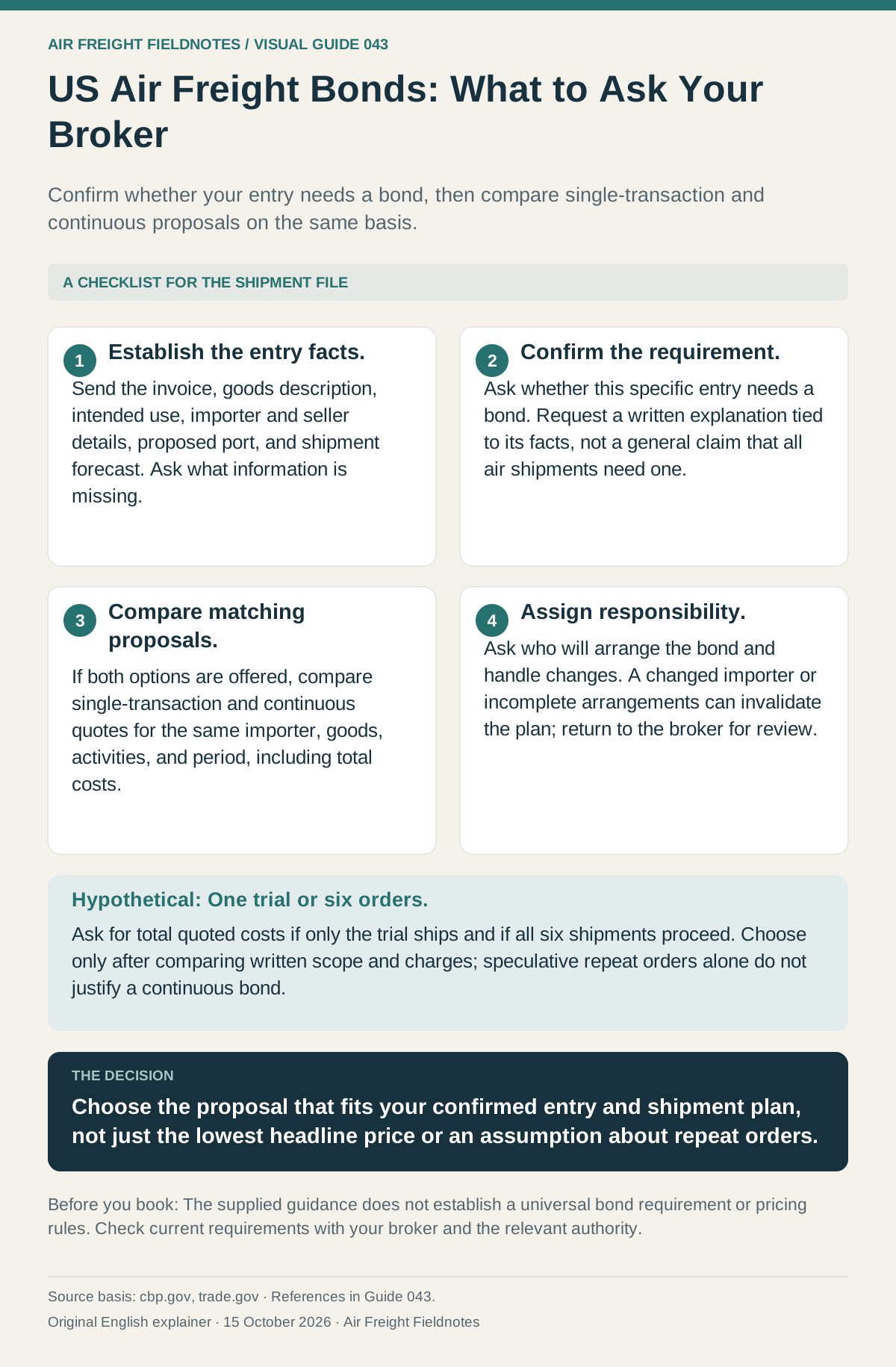
Read the infographic as text
Confirm whether your entry needs a bond, then compare single-transaction and continuous proposals on the same basis.
- 1. Establish the entry facts. Send the invoice, goods description, intended use, importer and seller details, proposed port, and shipment forecast. Ask what information is missing.
- 2. Confirm the requirement. Ask whether this specific entry needs a bond. Request a written explanation tied to its facts, not a general claim that all air shipments need one.
- 3. Compare matching proposals. If both options are offered, compare single-transaction and continuous quotes for the same importer, goods, activities, and period, including total costs.
- 4. Assign responsibility. Ask who will arrange the bond and handle changes. A changed importer or incomplete arrangements can invalidate the plan; return to the broker for review.
Hypothetical: One trial or six orders. Ask for total quoted costs if only the trial ships and if all six shipments proceed. Choose only after comparing written scope and charges; speculative repeat orders alone do not justify a continuous bond.
Decision: Choose the proposal that fits your confirmed entry and shipment plan, not just the lowest headline price or an assumption about repeat orders.
The supplied guidance does not establish a universal bond requirement or pricing rules. Check current requirements with your broker and the relevant authority.
Ask explicitly: “Who is the proposed importer of record, and has that party agreed to the role?” Separately identify the seller, buyer, broker, transport provider, and party arranging the bond. Have the broker confirm any combined roles in writing rather than treating a door-to-door service label as the answer.
The commercial invoice identifies the goods sold and the amount payable between exporter and buyer. The supplied export-document guidance distinguishes it from the pro forma invoice used during negotiations before shipment. Use that distinction when checking which document supports the broker’s assessment. [3]
For a China exporter, the practical task is to provide clear, consistent commercial information. For the overseas buyer, it is to confirm the proposed importer details and scope of the broker’s engagement. Ask the broker to flag discrepancies before you approve the bond proposal.
Use a pre-booking checklist and test the decision
Work through this checklist before accepting a quote. It is a planning tool, not a substitute for the broker’s entry-specific assessment.
- Send a precise product description and the available commercial invoice.
- State whether this is a one-off purchase, a trial order, or an expected recurring flow.
- Identify the proposed importer and ask how its importer number will be verified.
- Obtain a written answer on whether the proposed entry needs a bond.
- Request comparable single-transaction and continuous proposals where applicable.
- Check scope, charges, exclusions, payment terms, and required documents.
- Ask when the arrangement must be completed and how completion will be confirmed.
- Identify who handles corrections and who approves additional costs.
- Recheck the recommendation if the goods, value, importer, or shipping plan changes.

Hypothetical worked decision example: A US buyer plans one trial air shipment from China and may place five further orders. Assume the broker confirms that a bond is required for the proposed entry and offers both options. No prices or coverage amounts are assumed.
The buyer requests two comparisons: total quoted cost if only the trial ships, and total quoted cost if all six shipments proceed. The buyer also asks whether each proposal fits the same importer, goods, and planning period.
If repeat orders remain speculative, the buyer might choose the transaction-specific proposal after reviewing its scope and charges. If repeat orders become firm, the buyer might prefer the continuous proposal if the written comparison supports it. Neither choice is automatic.
The decision fails if later orders use a different importer, the proposals are not comparable, or required arrangements remain incomplete. The corrective action is to return to the broker with the changed facts—not assume the original quote still works.
FAQs about customs bond air freight planning
Does every air-freight shipment need a customs bond?
Do not assume so from the available guidance. It does not provide a universal requirement for air shipments. Ask your broker to assess the particular entry and explain the basis for the answer. [1]
Is a continuous bond always better for repeat shipments?
Do not decide from frequency alone. Request a comparison covering the same forecast, importer, activities, and period. Treat any preference as conditional on the written terms and the reliability of your shipment plan.
What should I send the broker first?
Start with the commercial invoice, a clear goods description, proposed importer details, and shipment forecast. The invoice establishes the goods sold and amount payable; CBP guidance also identifies the importer number as an entry-form requirement. Ask what else is needed for your case. [2] [3]
Sources and further reading
- Bonds | U.S. Customs and Border ProtectionPrimary source · Retrieved 15 October 2026
- Tips for New Importers and Exporters | U.S. Customs and Border ProtectionPrimary source · Retrieved 15 October 2026
- Common Export DocumentsPrimary source · Retrieved 15 October 2026
Field research
- Reddit field research 1Topic discovery and anecdotal context; not evidence of a general rule.
- Reddit field research 2Topic discovery and anecdotal context; not evidence of a general rule.
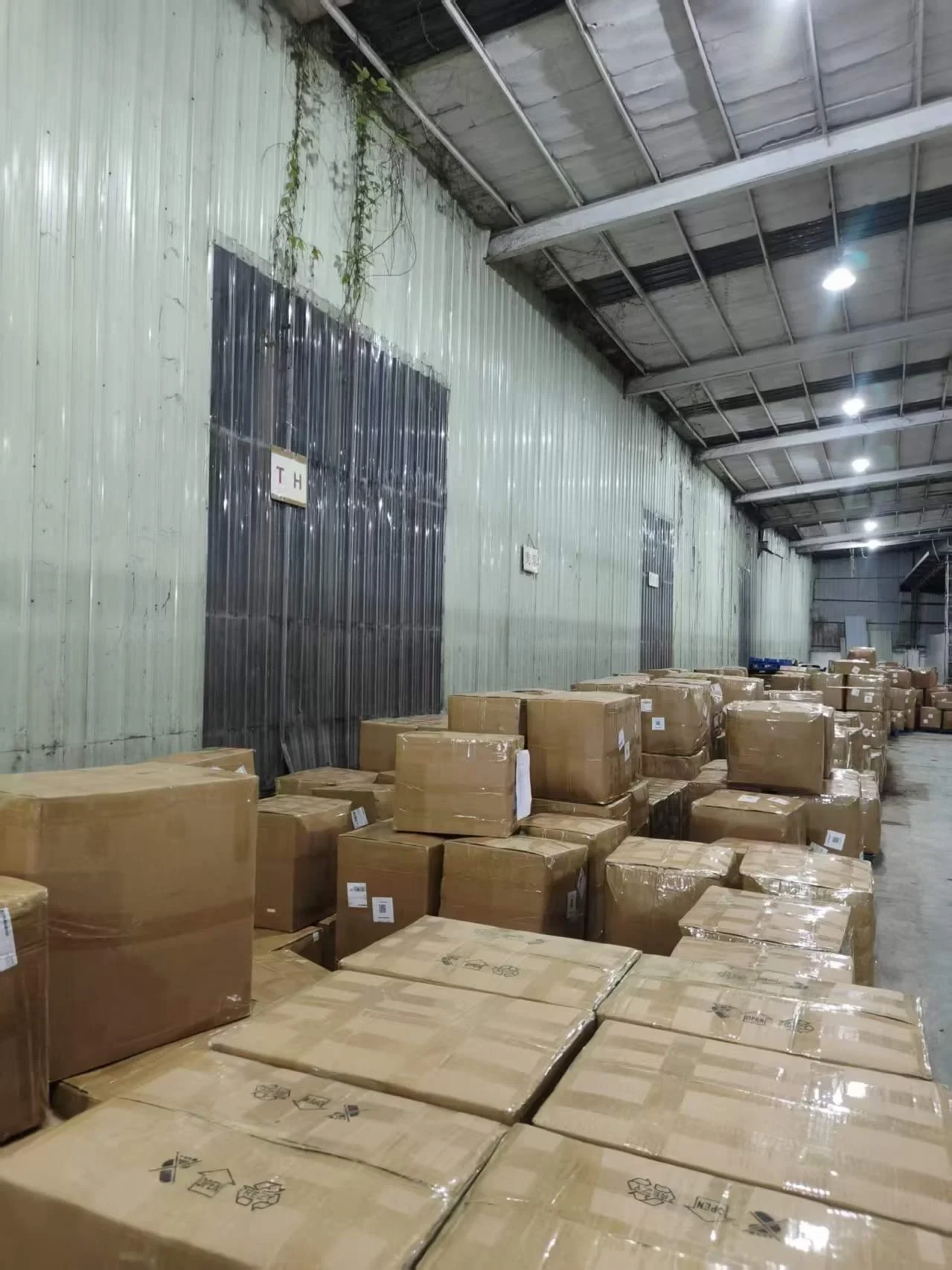
Prepared from the linked primary references and public field research. Field photographs illustrate general handling; worked examples use separate hypothetical figures. Acceptance, charges and destination requirements should be checked against the specific shipment and current operator or authority instructions.