 Skip to content
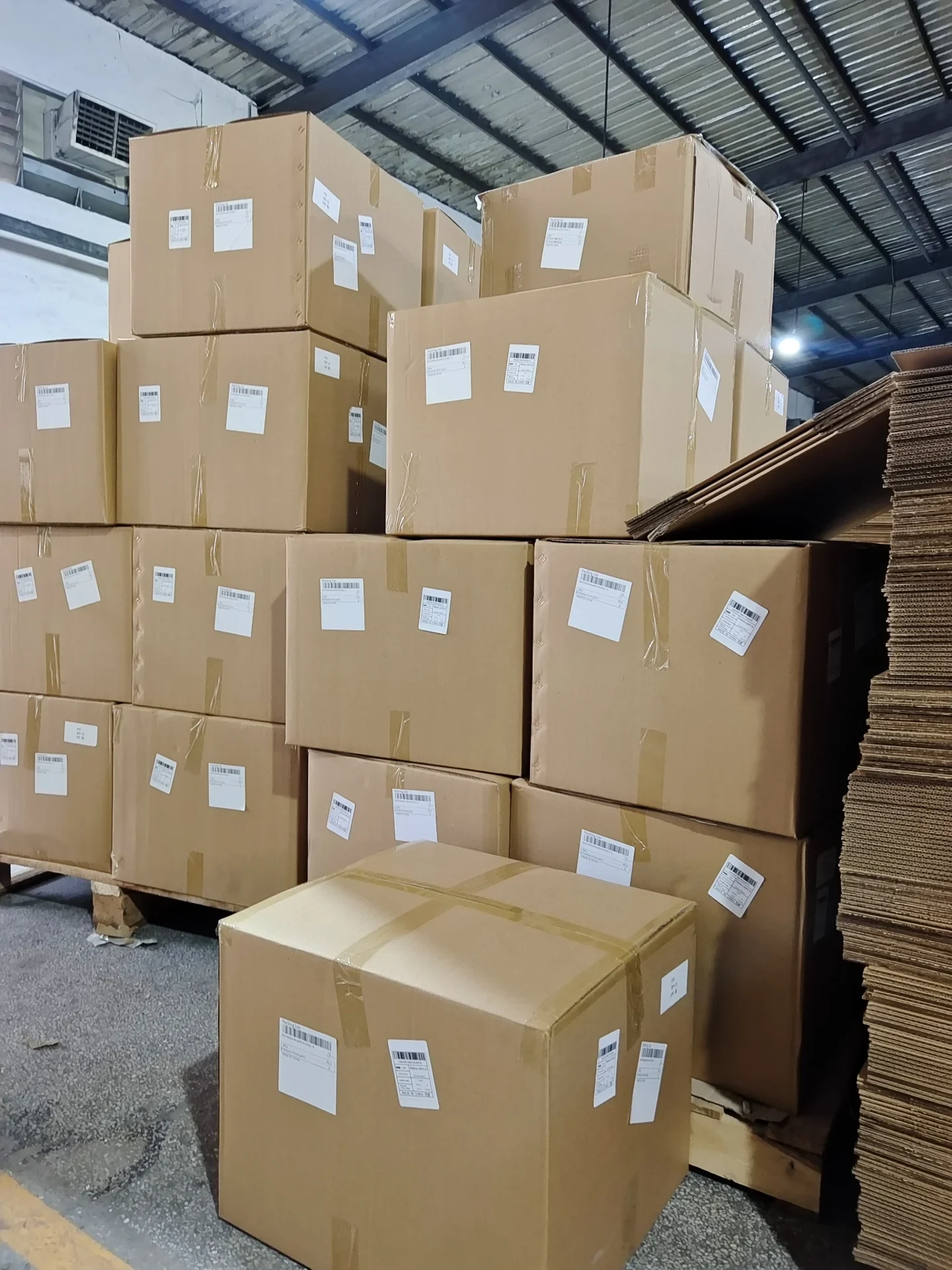
An air freight packing list shows what each package contains, how much it weighs, and how large it is outside. Use package marks to connect cartons with SKU quantities. Record net and gross weights separately, then check totals against shipment documents before sending the list to your forwarder or buyer. [1][3]
What an air freight packing list should show
A packing list itemizes goods by package rather than merely describing the shipment as a whole. It gives freight forwarders weight and measurement information and helps customs officials check the contents of a particular carton. For a China exporter and an overseas buyer, the practical goal is a document that connects each physical package to its contents. [1]
The supplied export-document guidance identifies seller, buyer, shipper, invoice number, shipment date, transport mode, carrier, quantities, descriptions, package types, package count, net and gross weights in kilograms, and package marks. It also includes dimensions where appropriate. Use these as a starting structure, then confirm destination-specific needs with the buyer/importer or forwarder. Some shipments require additional documents. [3]
For the template below, add an internal document reference and revision number as practical controls. These are recommendations, not requirements established by the cited references. Their purpose is to make it easier for everyone to identify the same version when packing changes. [3]
A reusable template with two illustrative package lines
Start with a header containing the seller, buyer, shipper, commercial invoice reference, shipment date, transport mode, carrier, and total number of packages. Then use one line per package where practical. The following two-line packing list is hypothetical; its products, marks, measurements, and weights are invented solely to demonstrate the layout. [3]
| Package mark and type | SKU, description, and quantity | Net weight, kg | Gross weight, kg | Outside dimensions, cm, L × W × H |
|---|---|---|---|---|
| PO482-C01; carton | SKU-A: cotton pouches, 80 pcs | 8.0 | 9.2 | 50 × 40 × 30 |
| PO482-C02; carton | SKU-A: cotton pouches, 20 pcs; SKU-B: cotton tote bags, 30 pcs | 7.0 | 8.4 | 45 × 35 × 30 |

Hypothetical totals: two cartons; SKU-A, 100 pieces; SKU-B, 30 pieces; net weight, 15.0 kg; gross weight, 17.6 kg. These totals summarize the two lines but do not replace them. Keeping the package detail preserves the link between a carton mark and its contents—the central function of a packing list. [1][3]
In this template, net weight means the goods without their shipping packaging; gross weight includes the packaging assigned to that package. Measure the outside of the completed package and label the dimension order and units. These are recommended working conventions: confirm that your forwarder uses the same basis, particularly where pallets or outer crates are involved. [1][3]
Choose detail that survives handling and checking
The comparison below translates the sources’ package-level approach into practical choices. The suggested methods are recommendations, not universal document rules. The test is whether a person examining one package can find its contents, weight, and measurements without guessing. [1][3]
| Field | Less useful approach | Recommended approach |
|---|---|---|
| Weights | Shipment gross weight only | Net and gross weight per package, plus totals |
| Dimensions | “Standard carton,” without units | Outside L × W × H for each packed package, with units |
| SKU mapping | Combined SKU totals only | Each SKU and quantity mapped to its package mark |
| Package marks | “Carton” repeated on every line | Distinct marks matching the physical packages |
| Mixed cartons | “Assorted goods” | Separate descriptions and quantities within the carton entry |
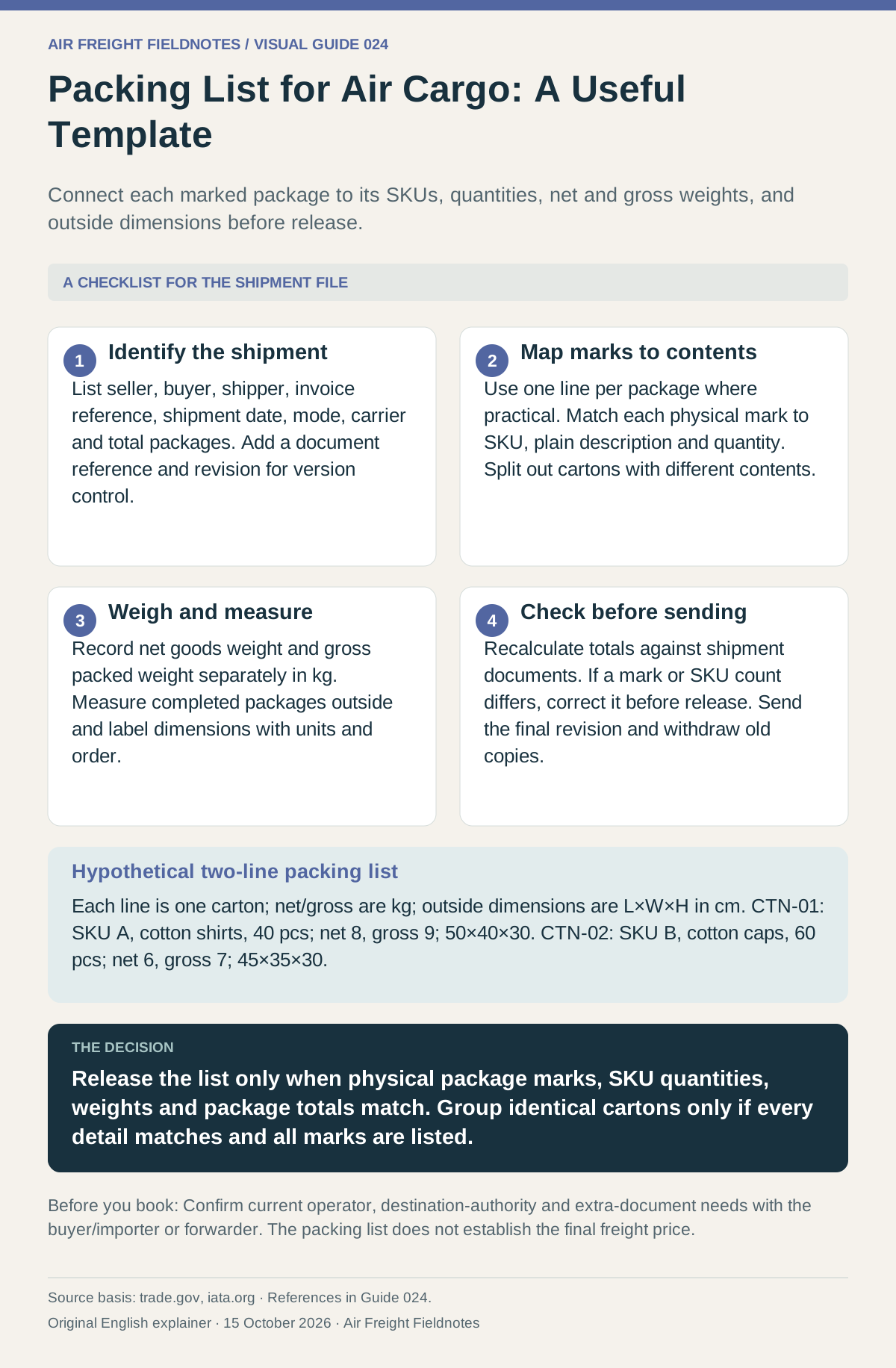
Read the infographic as text
Connect each marked package to its SKUs, quantities, net and gross weights, and outside dimensions before release.
- 1. Identify the shipment List seller, buyer, shipper, invoice reference, shipment date, mode, carrier and total packages. Add a document reference and revision for version control.
- 2. Map marks to contents Use one line per package where practical. Match each physical mark to SKU, plain description and quantity. Split out cartons with different contents.
- 3. Weigh and measure Record net goods weight and gross packed weight separately in kg. Measure completed packages outside and label dimensions with units and order.
- 4. Check before sending Recalculate totals against shipment documents. If a mark or SKU count differs, correct it before release. Send the final revision and withdraw old copies.
Hypothetical two-line packing list Each line is one carton; net/gross are kg; outside dimensions are L×W×H in cm. CTN-01: SKU A, cotton shirts, 40 pcs; net 8, gross 9; 50×40×30. CTN-02: SKU B, cotton caps, 60 pcs; net 6, gross 7; 45×35×30.
Decision: Release the list only when physical package marks, SKU quantities, weights and package totals match. Group identical cartons only if every detail matches and all marks are listed.
Confirm current operator, destination-authority and extra-document needs with the buyer/importer or forwarder. The packing list does not establish the final freight price.
A useful inference is that clear package marks reduce ambiguity during checking: the sources describe customs checking specific packages and export lists recording package marks. They do not establish a universal marking format. Agree on a readable format with the parties handling the shipment rather than treating the example above as mandatory. [1][3]
Check the list before release: a worked decision
Hypothetical decision: the exporter initially considers listing only “130 textile items, two cartons, 17.6 kg gross.” The buyer wants to identify which carton contains SKU-B. The exporter chooses the two-line layout because it locates all 30 SKU-B pieces in PO482-C02 while retaining shipment totals. This illustrates the package-checking purpose described in the sources; it is not a reported shipment outcome. [1][3]
This example assumes two loose cartons, final packing, and no additional pallet or crate. It fails as a final packing record if goods move between cartons, packaging changes, or an outer handling unit is added without revising the list. The recommended response is to recheck affected contents, weights, dimensions, and totals, then confirm with the forwarder how the handling units should be shown. [1][3]
Use this recommended release checklist to turn the source fields into a repeatable review. It is a document-quality check, not a substitute for destination or product-specific advice. [3]
- Confirm seller, buyer, shipper, and invoice reference.
- Count the physical packages and match every package mark.
- Map each SKU and quantity to the correct package.
- Check descriptions instead of relying on SKU codes alone.
- Record net and gross weights separately in kilograms.
- Measure completed packages and state dimension units and order.
- Recalculate package, SKU, net-weight, and gross-weight totals.
- Ask the buyer/importer or forwarder about additional documentation.
- Share the final revision and withdraw superseded copies.

Frequently asked questions
Can I list several identical cartons on one line?
As a practical recommendation, group them only when their contents, quantities, weights, and dimensions genuinely match, and identify every package mark covered. Split out exceptions. The sources require package detail but do not prescribe a particular spreadsheet layout. [1][3]
Should a copy go inside or outside the package?
The supplied packing-list guidance recommends including the list in the carton or package and says it can be attached outside with a copy inside. Confirm the preferred placement with your forwarder for the actual packing arrangement. [1]
Does the packing list establish the final freight cost?
No final-price conclusion follows from the available guidance. It says forwarders use packing-list weights and measurements to determine freight costs; it does not supply a tariff, chargeable-weight formula, or quotation terms. Ask the forwarder to explain the pricing basis separately. [1]
Sources and further reading
- Packing ListPrimary source · Retrieved 15 October 2026
- Common Export DocumentsPrimary source · Retrieved 15 October 2026
Field research
- Reddit field research 1Topic discovery and anecdotal context; not evidence of a general rule.
- Reddit field research 2Topic discovery and anecdotal context; not evidence of a general rule.

Prepared from the linked primary references and public field research. Field photographs illustrate general handling; worked examples use separate hypothetical figures. Acceptance, charges and destination requirements should be checked against the specific shipment and current operator or authority instructions.