 Skip to content

An air freight minimum charge is the quoted floor for freight, not necessarily the shipment’s total bill. Compare it with weight-based freight, then check whether an allowed higher weight break costs less. Confirm dimensional rules, rating permissions, surcharges and service scope before choosing the lowest quoted option for your shipment.
Read the minimum charge alongside the rate breaks
Airline–forwarder rates can be general, promotional, contractual or shipment-specific spot rates. They may differ from published tariffs, and spot pricing can reflect available capacity. Therefore, a rate sheet is not enough to establish your payable price: use the written quotation and its applicable conditions. [2]
For quote analysis, treat the air freight minimum charge as the lowest freight amount payable under that quotation. A quoted weight break is a weight threshold paired with a rate. These are working definitions for reading an offer, not proof that every provider uses identical rules. Ask the provider to confirm both meanings. [2]

In a hypothetical quotation, “minimum freight: 300 currency units” means a calculated freight amount of 240 becomes 300. It does not, by itself, mean pickup, clearance, delivery or other charges are included. Likewise, “100 kg and above: 4 units/kg” does not establish whether a lighter shipment may be rated at 100 kg. Those permissions must appear in the agreed terms.
The practical recommendation is to request both the calculation and its scope. Separate the freight minimum, any other quoted minimums, and charges outside freight. Negotiated rates and add-ons make a single headline price an incomplete basis for comparison. [2]
Check chargeable weight before checking tariff weight
Dimensional weight measures package space relative to actual weight. FedEx describes charging on dimensional or actual weight, whichever is greater. This supports checking both measures, but it does not establish a universal air-cargo divisor, rounding method or shipment-aggregation rule. Confirm those details in your quotation. [1]
In the hypothetical calculations below, chargeable weight means the greater of actual and dimensional weight, after applying the assumed contractual rules. Tariff weight, or rating weight, means the weight used to price the selected rate line. This article uses that distinction for clarity; ask your provider how its own documents use these labels.

The two checks answer different questions: “How much shipment weight must be charged?” and “Which permitted weight-and-rate combination produces the freight price?” In the worked example, chargeable weight is 80 kg, but an expressly allowed higher-break calculation uses 100 kg. The extra 20 kg is a pricing input, not extra physical cargo.
Packaging can affect the first check. Oversized packaging occupies more space and can increase dimensional weight; more efficient packing may reduce that effect. Do not assume that reducing dimensions will reduce the invoice, however: as a quote-analysis inference, the minimum freight or another applicable charge may still control. [1][2]
| Quote item | What it tests | What to confirm |
|---|---|---|
| Actual weight | Physical shipment mass | Final packed weight and measurement basis |
| Dimensional weight | Space converted into weight | Divisor, dimensions, rounding and aggregation |
| Chargeable weight | Applicable shipment weight | How actual and dimensional weight are compared |
| Tariff or rating weight | Weight used with a selected rate | Whether higher-break rating is permitted |
| Minimum freight | Floor for the freight calculation | Which freight items the floor covers |
| Total quoted cost | Comparable shipment spend | Included services, exclusions and variable charges |
Read the infographic as text
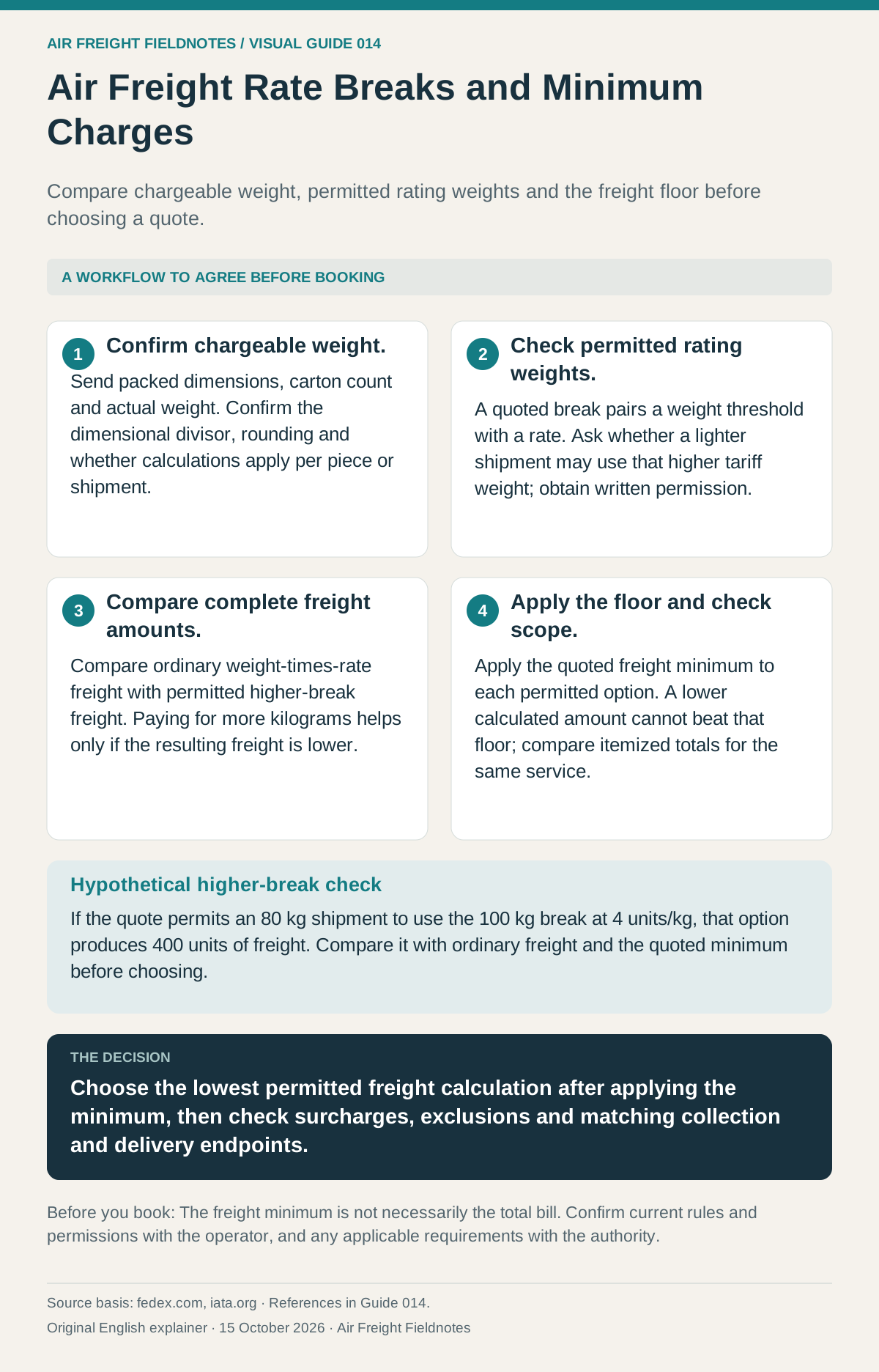
Compare chargeable weight, permitted rating weights and the freight floor before choosing a quote.
- 1. Confirm chargeable weight. Send packed dimensions, carton count and actual weight. Confirm the dimensional divisor, rounding and whether calculations apply per piece or shipment.
- 2. Check permitted rating weights. A quoted break pairs a weight threshold with a rate. Ask whether a lighter shipment may use that higher tariff weight; obtain written permission.
- 3. Compare complete freight amounts. Compare ordinary weight-times-rate freight with permitted higher-break freight. Paying for more kilograms helps only if the resulting freight is lower.
- 4. Apply the floor and check scope. Apply the quoted freight minimum to each permitted option. A lower calculated amount cannot beat that floor; compare itemized totals for the same service.
Hypothetical higher-break check If the quote permits an 80 kg shipment to use the 100 kg break at 4 units/kg, that option produces 400 units of freight. Compare it with ordinary freight and the quoted minimum before choosing.
Decision: Choose the lowest permitted freight calculation after applying the minimum, then check surcharges, exclusions and matching collection and delivery endpoints.
The freight minimum is not necessarily the total bill. Confirm current rules and permissions with the operator, and any applicable requirements with the authority.
This table is a quotation-review framework, not a universal tariff schedule. Its dimensional-weight comparison follows S1; its emphasis on checking rate conditions and add-ons follows S2. [1][2]
Work through a hypothetical pivot decision
Hypothetical example: A China exporter requests air freight for four cartons, each measuring 50 × 40 × 40 cm, with a combined actual weight of 80 kg. Assume the contract uses a divisor of 6,000, no further rounding, and these freight-only terms:
- Below 100 kg: 5.50 currency units/kg.
- At 100 kg and above: 4.00 currency units/kg.
- Minimum freight: 300 currency units.
- Rating a lighter shipment at the 100 kg break is expressly permitted.
Total volume is 320,000 cm³. Dividing by the hypothetical contractual divisor of 6,000 gives 53.33 kg dimensional weight. Actual weight is higher, so chargeable weight is 80 kg. A divisor of 5,000 would instead give 64 kg; actual weight would still control. Neither divisor is presented as a universal rule.
At the lower bracket, freight is 80 × 5.50 = 440 units. At the allowed higher break, freight is 100 × 4.00 = 400 units. Both exceed the 300-unit minimum. The higher-break calculation therefore saves 40 units on freight under these assumptions.
The pivot weight is where the two calculations meet: 400 ÷ 5.50 = approximately 72.73 kg. Above that point and below 100 kg, paying for 100 kg is cheaper in this example. At the pivot they are equal; below it, the lower-bracket calculation is cheaper before testing the minimum.
This decision fails if higher-break rating is prohibited, final measurements change, or another applicable condition changes the calculation. The result also establishes only a freight saving, not a total-cost saving. Fuel surcharges can change, and air-cargo pricing can include surcharges and add-ons. [2][3]
Use this checklist before accepting a quotation
The following checklist is a practical recommendation from dimensional pricing, negotiated air-cargo rates and changeable fuel surcharges. It is intended to uncover missing assumptions rather than prescribe carrier rules. [1][2][3]
- Send packed measurements: provide carton count, dimensions and actual weight.
- Confirm dimensional rules: record the divisor, rounding and whether calculations apply per piece or shipment.
- Request the rate ladder: obtain relevant breaks, currency and quotation validity.
- Identify every minimum: distinguish minimum freight from other quoted minimum charges.
- Ask about higher-break rating: obtain written permission and the resulting rating weight.
- Recalculate: compare ordinary freight, permitted higher-break freight and the minimum.
- Match service scope: compare offers covering the same collection and delivery endpoints.
- List exclusions: ask which additional charges could apply and how they are calculated.
- Check changes: confirm what happens after remeasurement or surcharge adjustment.

Frequently asked questions
Is the air freight minimum charge the total shipping price?
Not necessarily. Treat it as the freight floor unless the quotation explicitly defines a broader scope. Ask for an itemized total and exclusions; negotiated air-cargo pricing can include surcharges and add-ons beyond the base rate. [2]
Can paying for more kilograms cost less?
Yes, in the hypothetical example, because the quotation expressly permits using the 100 kg rate for an 80 kg shipment. Do not assume that permission elsewhere. Compare the complete weight-times-rate amounts, not just the lower per-kilogram number.
Will smaller cartons always lower the bill?
No. Smaller packaging may reduce dimensional weight, but actual weight can remain higher. As a calculation inference, even a lower chargeable weight may leave freight unchanged when the quoted minimum still controls. Check both weight and pricing before repacking. [1]
Sources and further reading
- What is Dimensional Weight? | FedExPrimary source · Retrieved 15 October 2026
- IATA - Air Cargo Tariffs and Rules: What You Need to KnowPrimary source · Retrieved 15 October 2026
- Weekly Fuel Surcharge Changes | FedExPrimary source · Retrieved 15 October 2026
Field research
- Reddit field research 1Topic discovery and anecdotal context; not evidence of a general rule.
- Reddit field research 2Topic discovery and anecdotal context; not evidence of a general rule.
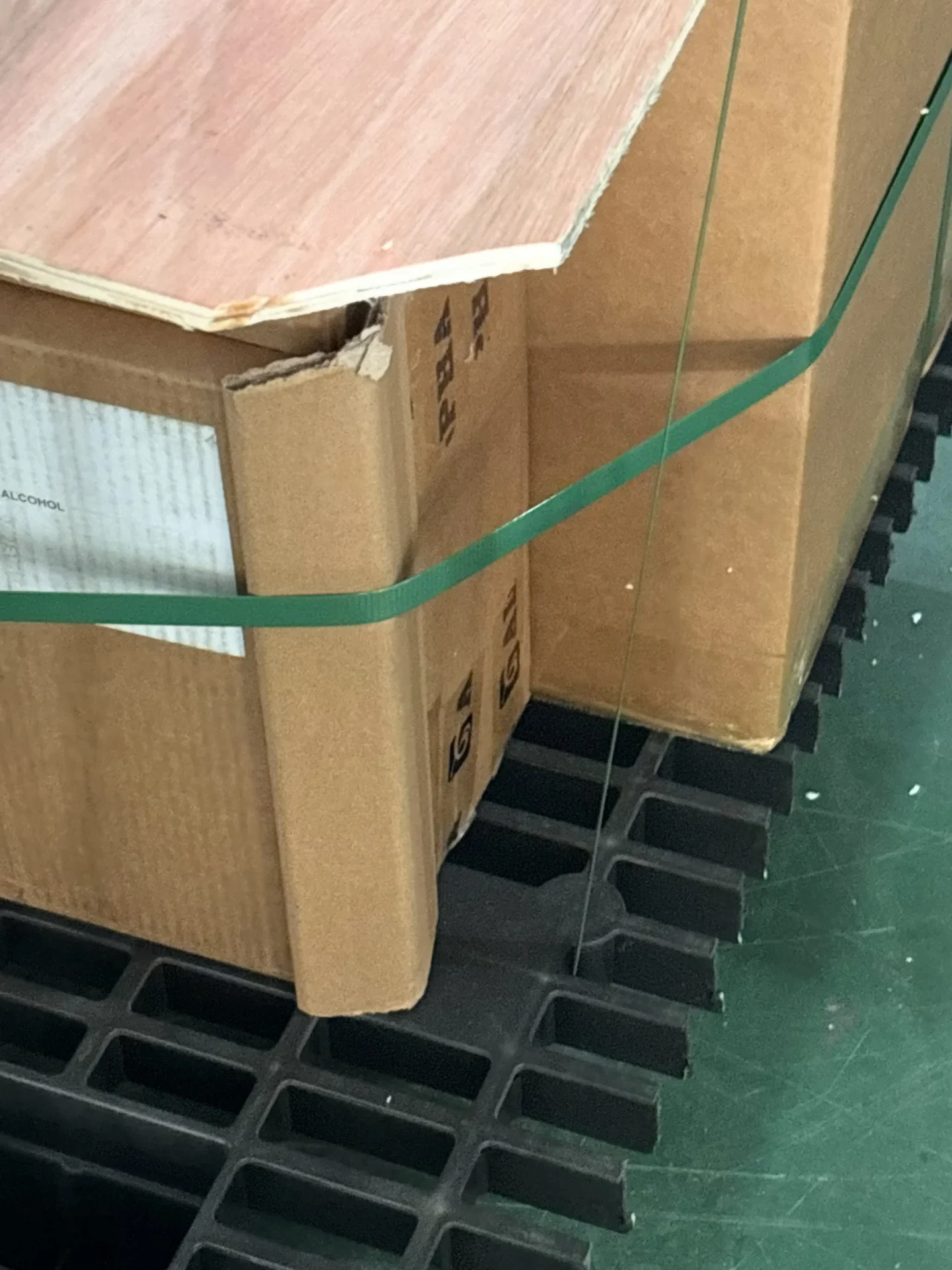
Prepared from the linked primary references and public field research. Field photographs illustrate general handling; worked examples use separate hypothetical figures. Acceptance, charges and destination requirements should be checked against the specific shipment and current operator or authority instructions.