 Skip to content
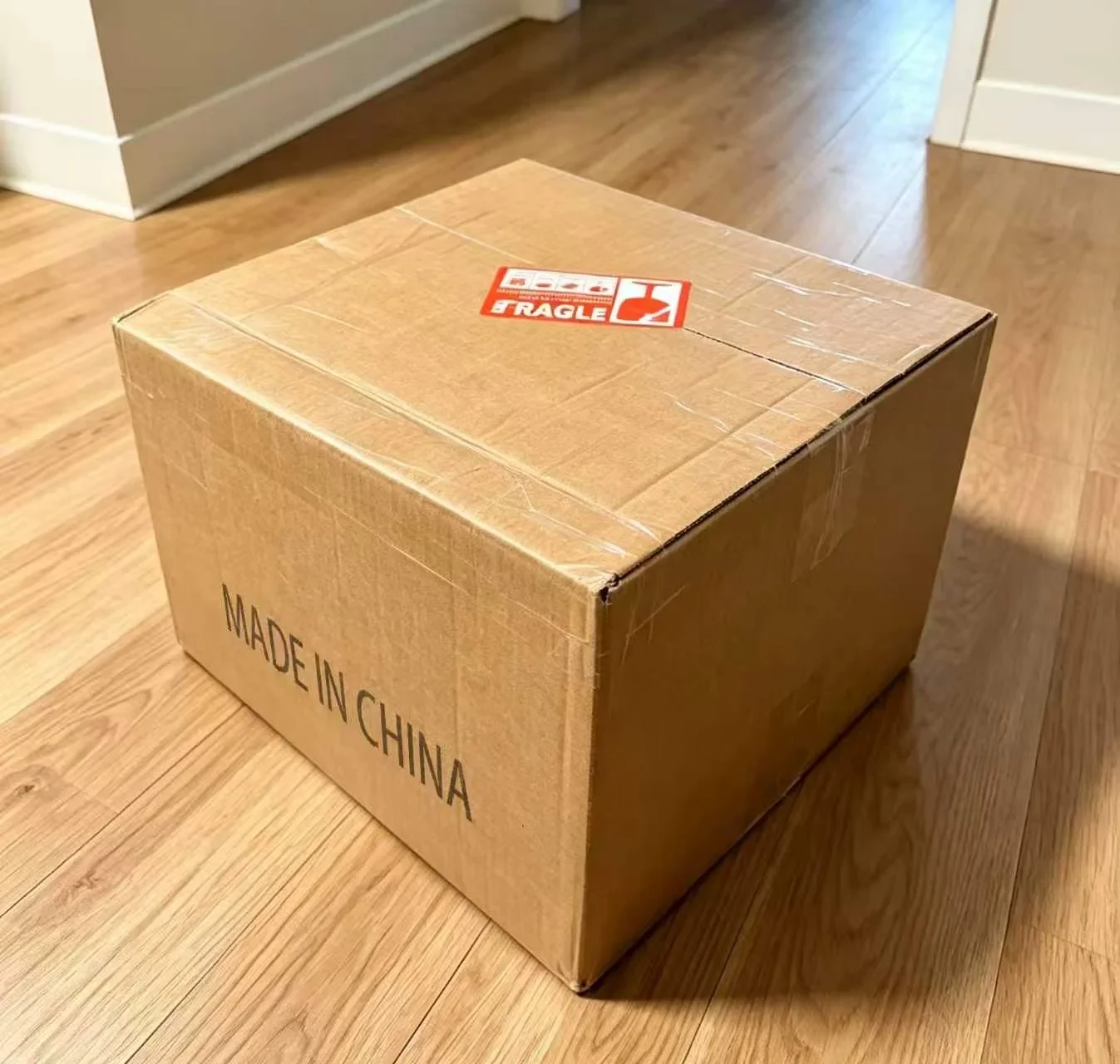
Air freight rates from China are meaningful only when tied to a defined shipment and quote scope. Compare the lane, commodity, validity period, chargeable weight, minimum charge, and exclusions rather than a headline price. Ask for a written breakdown before booking because airport transport rates do not describe every cost. [3]
Define the shipment before comparing prices
IATA puts correct identification of the goods before classification, packaging, handling, and assessment of tariffs and fees. Its guidance also distinguishes a transport rate per unit of weight from additional charges. A useful comparison therefore starts with the same shipment description, not two isolated per-kilogram figures. [3]
For a China exporter or overseas buyer, the practical recommendation is to send each provider one identical quote request. State the collection point in China, destination airport or delivery address, goods description, package count, packed dimensions, gross weight, and expected readiness date. This is a comparison method inferred from the importance of shipment identification and weight-based pricing, not a universal booking form. [1][3]

Ask the provider to confirm the quoted lane and commodity in writing. “China to Europe” is not a sufficiently precise comparison scope: name the origin and destination points you want priced. Likewise, request confirmation that the offer applies to your actual goods, rather than assuming an offer for another commodity applies. These are recommended controls for making comparable requests. [3]
Make the quote date-bound. Request an issue date, validity end date, and explanation of what must happen before expiry: acceptance, booking, cargo receipt, or another stated event. Do not assume a valid price also confirms space or a departure. These are recommended contractual questions; the available guidance does not establish current availability, schedules, or lane prices. [3]
Calculate chargeable weight using the quoted rule
Dimensional weight measures how much space a package occupies relative to its actual weight. FedEx explains that its dimensional pricing uses the greater of dimensional weight and actual weight. This is why a light but bulky shipment can have a pricing weight above its scale weight. [1]
For comparison, request the provider’s dimensional formula, measurement units, rounding rules, and calculation level. Establish whether the calculation is performed package by package or on an agreed shipment total. These are recommended checks: the available guidance supports the dimensional-weight principle but does not establish one universal divisor or rounding method. [1]

Hypothetical calculation: assume ten identical cartons, each measuring 60 × 40 × 40 centimetres, with a combined actual weight of 120 kilograms. Their combined volume is 960,000 cubic centimetres. Under an expressly agreed divisor of 6,000, dimensional weight is 160 kilograms; under 5,000, it is 192 kilograms. Both divisors here are contractual examples, not universal rules. Applying the greater-weight principle gives 160 or 192 kilograms respectively, before any agreed rounding. [1]
The failure case is comparing per-kilogram prices while overlooking different weight calculations. Ask for the calculated chargeable weight beside the unit rate. Reducing unnecessary packaging may reduce dimensional weight, but any redesign must still suit the goods; do not treat smaller packaging as a guaranteed saving. [1]
Separate minimums, transport charges, and exclusions
IATA describes air cargo transport rates as covering movement between airports and distinguishes those rates from additional charges connected with carriage. Consequently, an airport transport figure should not be read as a complete collection-to-delivery budget. Request an itemised scope instead. [3]
| Quote element | What to compare | Question to resolve |
|---|---|---|
| Lane and commodity | Same named points and goods | Does this offer cover my shipment? |
| Chargeable weight | Actual weight, dimensional weight, and selected result | Which formula and rounding rules apply? |
| Transport rate | Unit price multiplied by agreed pricing weight | Is this airport transport only? |
| Minimum charge | Written minimum and its application | Does it replace a smaller calculated amount? |
| Other charges | Named inclusions, exclusions, and charging units | Which amounts remain unpriced? |
| Validity | Expiry and conditions for retaining the offer | What event fixes the quoted price? |
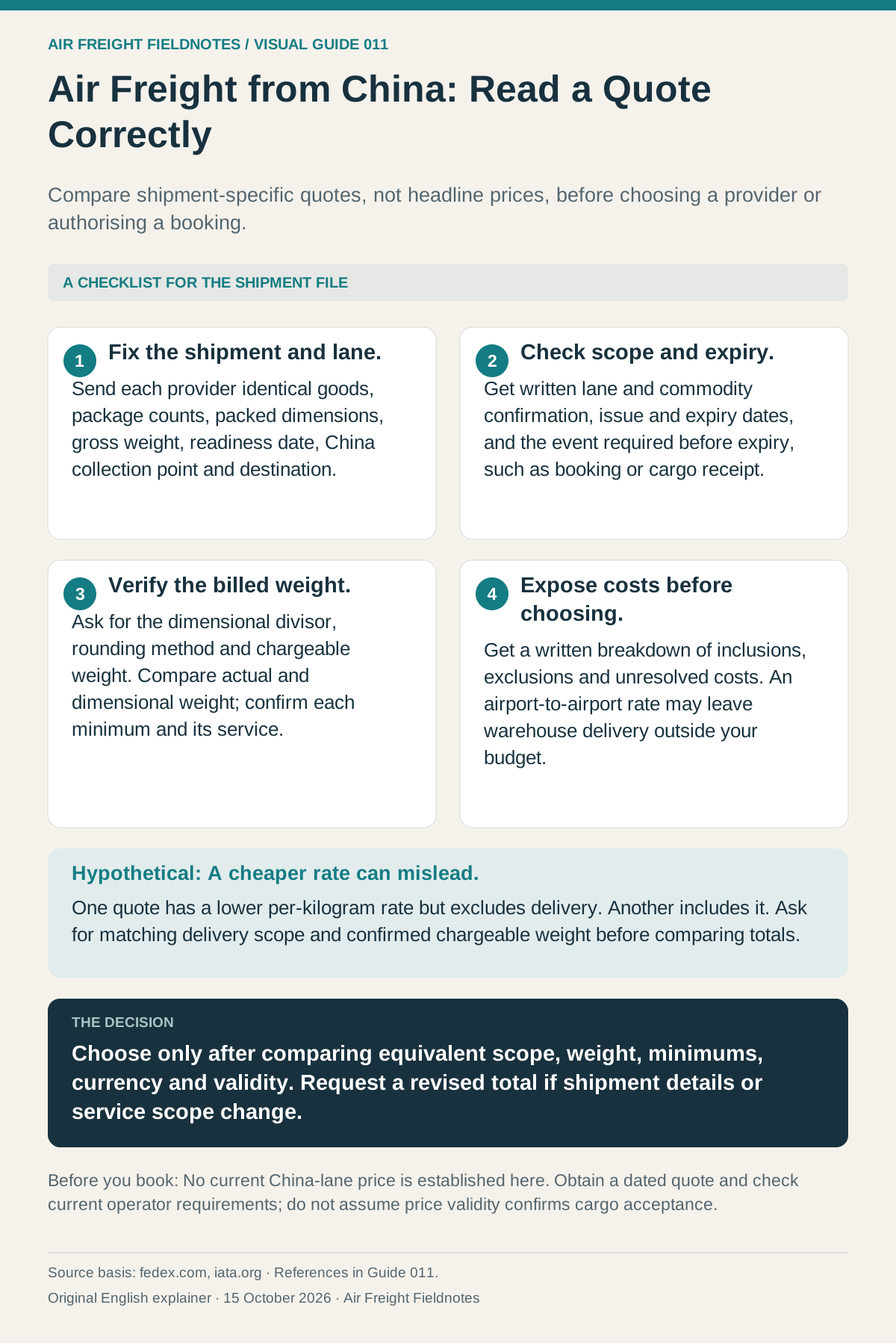
Read the infographic as text
Compare shipment-specific quotes, not headline prices, before choosing a provider or authorising a booking.
- 1. Fix the shipment and lane. Send each provider identical goods, package counts, packed dimensions, gross weight, readiness date, China collection point and destination.
- 2. Check scope and expiry. Get written lane and commodity confirmation, issue and expiry dates, and the event required before expiry, such as booking or cargo receipt.
- 3. Verify the billed weight. Ask for the dimensional divisor, rounding method and chargeable weight. Compare actual and dimensional weight; confirm each minimum and its service.
- 4. Expose costs before choosing. Get a written breakdown of inclusions, exclusions and unresolved costs. An airport-to-airport rate may leave warehouse delivery outside your budget.
Hypothetical: A cheaper rate can mislead. One quote has a lower per-kilogram rate but excludes delivery. Another includes it. Ask for matching delivery scope and confirmed chargeable weight before comparing totals.
Decision: Choose only after comparing equivalent scope, weight, minimums, currency and validity. Request a revised total if shipment details or service scope change.
No current China-lane price is established here. Obtain a dated quote and check current operator requirements; do not assume price validity confirms cargo acceptance.
This table is a recommended comparison framework, inferred from the distinction between transport rates, additional charges, and dimensional pricing. It does not imply that every quote contains every listed charge or uses the same commercial rules. [1][3]
For a minimum, ask whether it applies to transport alone or to another named service. If the provider confirms a simple transport minimum, compare that minimum with the weight-based transport amount and use the larger figure. Do not apply that method to the whole invoice unless the written terms say so. This is a conditional calculation method, not an asserted industry-wide rule. [3]
Ask whether collection, origin handling, documentation, destination handling, clearance services, final delivery, duties, and taxes are included, excluded, or awaiting assessment. This is a suggested enquiry list, not evidence that every item is payable. Mark unknown costs as unresolved rather than treating them as zero. [3]

Use a worked comparison and a booking checklist
Clearly hypothetical decision example: use the ten-carton shipment above. Offer A specifies a 6,000 divisor, 160 chargeable kilograms, a transport price of 4 currency units per kilogram, and a 700-unit transport minimum. Its transport amount is therefore 700 units, not 640. Offer B specifies a 5,000 divisor, 192 chargeable kilograms, 3.8 units per kilogram, and no minimum: its transport amount is 729.60 units. These are invented teaching figures, not current air freight rates from China. [1][3]
Assume A also excludes a confirmed 100-unit service that B includes. On that matched scope, A totals 800 units and B totals 729.60 units. B is cheaper despite its higher transport amount. That conclusion fails if the services differ, measurements change, or either offer expires. The decision method is an inference: compare equivalent scope and expose unresolved assumptions before choosing. [1][3]
Use this recommended checklist before authorising a booking; it translates the supplied pricing principles into practical checks. [1][3]
- Confirm the exact lane, goods description, readiness date, and quote validity.
- Check final packed dimensions, package count, and actual gross weight.
- Obtain the dimensional divisor, rounding method, and chargeable weight.
- Confirm every minimum and what service it applies to.
- List included services, excluded services, and unresolved costs.
- Record the currency and any stated conversion basis.
- Request a revised total if shipment details or scope change.

FAQs about reading an air freight quote
Why is the charged weight higher than the scale weight?
The shipment may occupy enough space for dimensional weight to exceed actual weight. FedEx describes pricing based on whichever is greater. Ask the provider to show the measurements and formula used rather than assuming a particular divisor. [1]
Does an airport-to-airport rate include delivery to my warehouse?
Do not assume so. IATA describes air cargo transport rates as covering movement between airports. Request written confirmation of any collection, clearance, or delivery services beyond that transport scope, including their prices or unresolved status. [3]
Can I use a published per-kilogram figure as my budget?
Only as an incomplete input unless it matches your shipment and scope. Weight, dimensional pricing, and additional charges affect the calculation. The available guidance supports no current China-lane price, so obtain a dated, shipment-specific quote before making a purchasing decision. [1][3]
Sources and further reading
- What is Dimensional Weight? | FedExPrimary source · Retrieved 15 October 2026
- IATA - Air Cargo Tariffs and Rules: What You Need to KnowPrimary source · Retrieved 15 October 2026
Field research
- Reddit field research 1Topic discovery and anecdotal context; not evidence of a general rule.
- Reddit field research 2Topic discovery and anecdotal context; not evidence of a general rule.
Prepared from the linked primary references and public field research. Field photographs illustrate general handling; worked examples use separate hypothetical figures. Acceptance, charges and destination requirements should be checked against the specific shipment and current operator or authority instructions.