 Skip to content

The practical answer
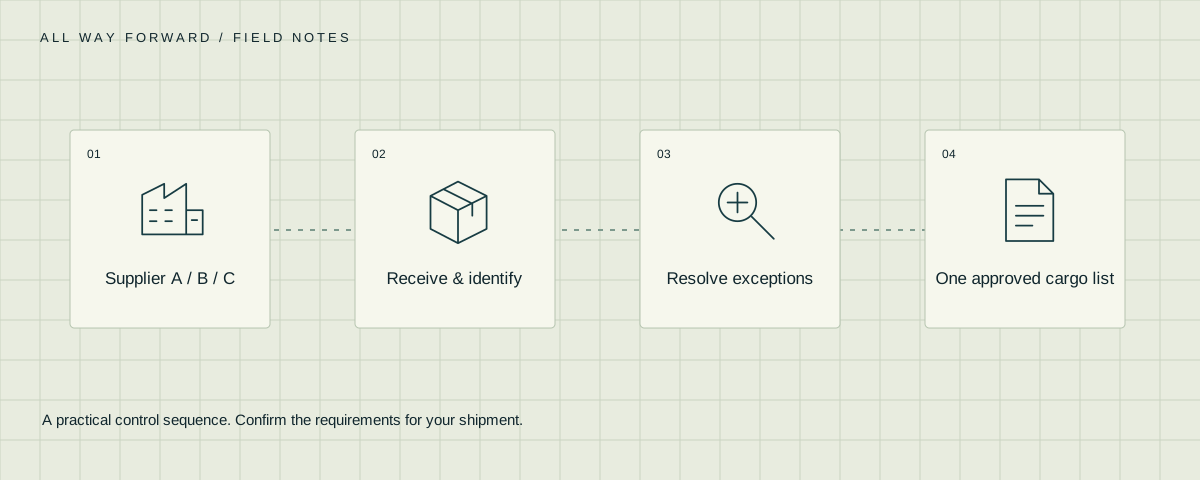
Consolidation works when every supplier’s cargo can be identified, received, checked and matched to the final shipment record. Agree the last receiving date and acceptance criteria before collection. Keep missing, damaged and unapproved items out of the “ready to ship” total.
Create one receiving register
Start with one line per purchase-order item or identifiable package group. Record supplier, PO, product, expected quantity, package count, estimated dimensions and weight, ready date and collection contact. Assign a unique package identifier that can also appear on the label, receiving photograph and packing list.
For a room project, add a room or installation-zone reference without replacing the transport identifier. The receiving warehouse needs a stable package number even if the buyer later changes the room layout.
Agree what the warehouse checks
A count check, visible-condition check, product inspection and functional test are different services. Specify the scope before goods arrive. For a sealed carton, a clean exterior does not prove the contents match the order. Record whether packages may be opened, who approves repacking and what happens to original labels.
Use four receiving states: expected, received pending check, exception, approved for shipment. Attach photographs to exceptions and record the decision owner. Do not combine a supplier’s promised quantity with the warehouse’s confirmed quantity in one total.
Re-measure after the final packing change
Crating, palletization and protective material can change both volume and gross weight. Rebuild the final packing list after approved rework, then update the forwarder and quote comparison. If packages cannot be stacked, supply the handling limitation and usable footprint as well as cubic volume.
For mixed furniture, stone and lighting, ask the packing team to plan compatibility and load distribution. The CTU Code treats packing and securing as a coordinated operation; a consolidation warehouse should not assume that any items with the same destination can be packed together without review. [1]
Decide how late goods will be handled
Set a last receiving target with the warehouse and booking coordinator. If one supplier is late, compare holding the whole shipment, shipping the available goods or moving the late items separately. Ask for the effect on storage, documentation, handling and transport; there is no automatic best answer.
Example: three suppliers are expected to deliver 24, 8 and 12 packages. The warehouse receives 24, 7 and 12. The approved record cannot show 44 packages simply because 44 were ordered. Resolve the missing package, or document the agreed partial shipment and update every affected document.
Before final release to transport, reconcile supplier receipts, exception approvals, final package IDs and the consolidated packing list. Save a signed-off version and the loading evidence.
Use before the next handoff
Your action checklist
Ticks stay in this browser. No shipment details are sent.
Common questions
Does consolidation include a full quality inspection?
Only if that inspection is included in the agreed service. Confirm the inspection scope, sampling, evidence and rework authority.
Can I use factory measurements for the final booking?
Use the actual final packed measurements. Factory estimates may change after crating or palletization.
Sources & scope
Primary references checked 21 October 2026. Carrier examples describe that provider’s process; confirm the requirements of your own booking and destination.
Editorial preparation: Allwayforward Editorial Team. The worksheets and worked examples are original planning aids, not carrier forms or a substitute for shipment-specific instructions.