 Skip to content
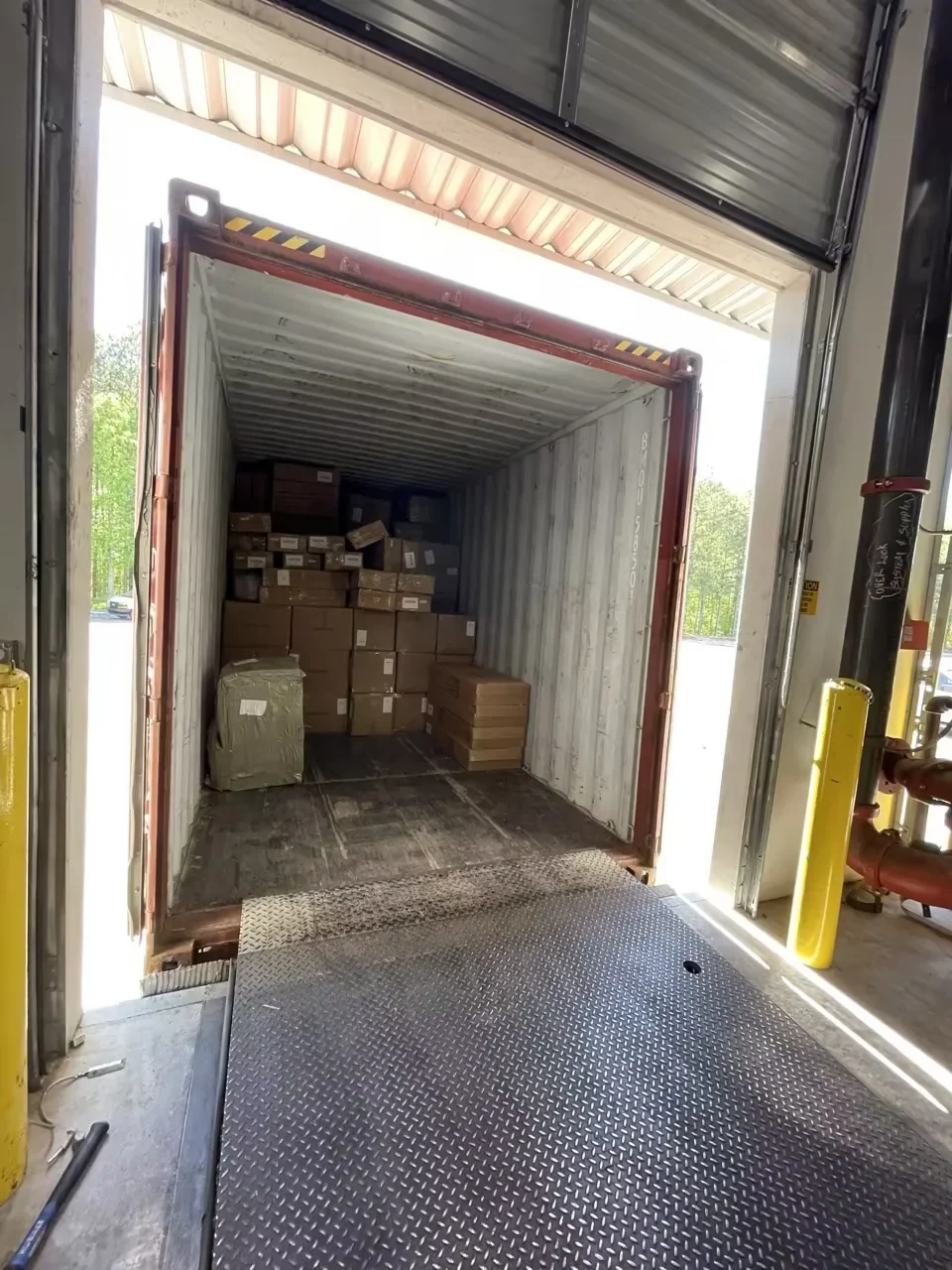
Use emergency air freight to protect a measured sales gap, not automatically move the entire purchase order. Estimate contribution at risk, subtract usable stock, and fly only the quantity justified by demand and timing. Keep the balance on sea freight, then review stock, arrival assumptions, and escalation triggers every day.
Define the stockout gap before choosing air freight
Start with one SKU, one destination, and one replenishment date. The planning method below is a recommendation, not a prediction of transport performance. Its purpose is to limit spending while making the consequences of a smaller air shipment visible.
Separate inventory arrival from inventory availability. For an FBA seller, fulfillment includes storage, packing, shipping orders, and handling returns and exchanges. Sending inventory to a fulfillment center is therefore only part of the wider fulfillment process. Do not treat a transport milestone as proof that stock is available for customer orders. [2]
Build the calculation around your expected sellable-stock date. Ask the forwarder and receiving team which steps their estimates include. Record uncertainty rather than replacing it with a confident delivery promise.

- Daily demand: use a stated forecast, with a separate higher-demand case.
- Usable stock: count only inventory you expect to sell before replenishment.
- Sea balance date: estimate when that stock will become sellable, not merely reach port.
- Air availability date: include the receiving work needed after transport.
- Contribution per unit: define which variable costs your calculation subtracts.
Use these planning formulas: gap units = forecast demand until sea stock is sellable − usable stock, with a minimum of zero. Then calculate contribution at risk = gap units × contribution per unit. Treat this as a scenario estimate, not a guaranteed loss.
Calculate a limited air quantity: hypothetical worked example
Hypothetical example: A China exporter and overseas buyer have a 1,200-unit purchase order ready for allocation. The buyer has 100 usable units, forecasts sales of 20 units daily, and expects the sea allocation to become sellable at the start of day 26. The planning horizon therefore contains 25 selling days.
Assume air stock becomes sellable at the start of day 4. Each otherwise lost sale would contribute $18 before the extra air expense. A hypothetical like-for-like quote comparison puts the incremental cost of air over sea at $6 per air-shipped unit. These are invented planning inputs, not rates or schedule evidence.

- Demand through day 25: 25 × 20 = 500 units.
- Uncovered demand: 500 − 100 = 400 units.
- Contribution at risk: 400 × $18 = $7,200.
- Proposed split: 400 units by air; 800 by sea.
- Incremental air expense: 400 × $6 = $2,400.
- Potential contribution protected after that expense: $7,200 − $2,400 = $4,800.
The inference is conditional: flying 400 units is economically preferable in this scenario if those units prevent otherwise lost sales. It does not establish that every sale would disappear during a stockout. Customers might wait, buy another product from the same seller, or cancel; adjust the assumed lost-sale share accordingly.
The 400-unit calculation contains no demand buffer. Existing stock covers five days, while the assumed air availability begins on day 4. That overlap supports the initial handoff, but total inventory still covers only the stated 25-day demand.
Compare the split with flying the whole purchase order
The table uses only the hypothetical inputs above. It measures the immediate gap, not long-term inventory value. It also assumes the incremental air expense scales evenly per unit; replace that assumption with actual comparable quotes before booking.
| Plan | Air / sea units | Extra air expense | Immediate gap result | Decision concern |
|---|---|---|---|---|
| Keep everything on sea | 0 / 1,200 | $0 | 400 units uncovered | Up to $7,200 contribution at risk |
| Fly the calculated bridge | 400 / 800 | $2,400 | Covered under base assumptions | No buffer for higher demand or later sea availability |
| Fly a smaller rescue | 200 / 1,000 | $1,200 | 200 units remain uncovered | Requires deliberate acceptance of remaining lost sales |
| Fly the entire order | 1,200 / 0 | $7,200 | Covered, with 800 extra units | No additional immediate-gap benefit established |
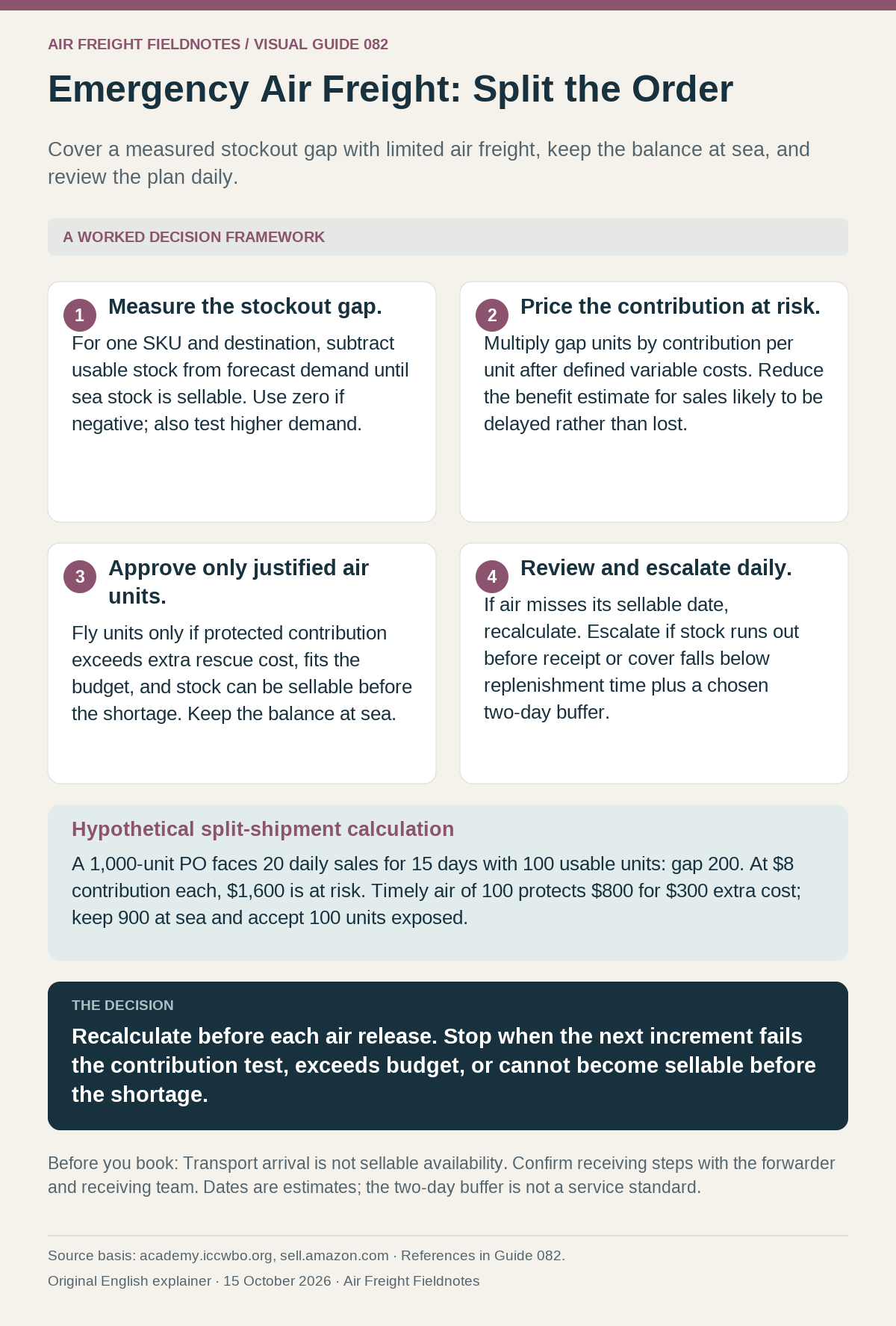
Read the infographic as text
Cover a measured stockout gap with limited air freight, keep the balance at sea, and review the plan daily.
- 1. Measure the stockout gap. For one SKU and destination, subtract usable stock from forecast demand until sea stock is sellable. Use zero if negative; also test higher demand.
- 2. Price the contribution at risk. Multiply gap units by contribution per unit after defined variable costs. Reduce the benefit estimate for sales likely to be delayed rather than lost.
- 3. Approve only justified air units. Fly units only if protected contribution exceeds extra rescue cost, fits the budget, and stock can be sellable before the shortage. Keep the balance at sea.
- 4. Review and escalate daily. If air misses its sellable date, recalculate. Escalate if stock runs out before receipt or cover falls below replenishment time plus a chosen two-day buffer.
Hypothetical split-shipment calculation A 1,000-unit PO faces 20 daily sales for 15 days with 100 usable units: gap 200. At $8 contribution each, $1,600 is at risk. Timely air of 100 protects $800 for $300 extra cost; keep 900 at sea and accept 100 units exposed.
Decision: Recalculate before each air release. Stop when the next increment fails the contribution test, exceeds budget, or cannot become sellable before the shortage.
Transport arrival is not sellable availability. Confirm receiving steps with the forwarder and receiving team. Dates are estimates; the two-day buffer is not a service standard.
Under these assumptions, flying the whole order spends another $4,800 compared with the bridge shipment without protecting more sales inside the defined gap. That is a scenario inference, not a universal argument against larger air shipments. A longer disruption or stronger demand could change the decision.
Book against clear responsibilities and review daily
Write down the named delivery point and risk-transfer arrangement instead of using a familiar trade label loosely. The supplied trade-contract guidance identifies FOB as maritime-only and stresses precise delivery and risk-transfer locations. Do not use FOB as shorthand for an air-freight handover. [1]
For this planning workflow, request a written responsibility map covering pickup, export work, air transport, import arrangements, final delivery, and receiving. Ask who performs each task and who pays each quoted charge. Do not infer responsibilities merely from a provider’s business description.

Actionable release checklist:
- Confirm SKU, available quantity, carton counts, dimensions, and weights with the exporter.
- Obtain comparable air and sea scopes, identifying included and excluded charges.
- Recalculate the bridge using the latest sellable-stock dates.
- Approve a maximum incremental spend and name the person authorized to change it.
- Issue separate air and sea allocation instructions, with quantities that reconcile to the PO.
- Confirm destination receiving requirements before dispatch.
- Assign one owner to update stock, demand, costs, and milestones daily.
For FBA inventory, keep the commercial calculation wider than transport alone: Amazon’s supplied guidance says item costs include fulfillment and storage and recommends considering margins when evaluating FBA. Use your own applicable cost inputs rather than assuming freight savings equal profit. [2]
Set a daily review trigger before release. In this hypothetical plan, escalate whenever projected stock reaches zero before the next sellable receipt, or when remaining cover falls below the current estimated replenishment interval plus two days. The two-day allowance is a chosen planning buffer, not a service standard.

Failure cases include demand rising above forecast, air stock missing its assumed availability date, sea stock becoming sellable later, and fewer units being usable than recorded. Recalculate the shortage first. Then compare a further limited air release, demand reduction, or an accepted stockout against the remaining contribution at risk.
FAQs about emergency air freight split shipments
Should I fly every unit that might sell before sea stock arrives?
Not automatically. In this framework, approve units whose expected protected contribution exceeds their incremental rescue cost, subject to your spending limit. Reduce the benefit estimate when sales are likely to be delayed rather than lost.
What if the sea arrival estimate changes after booking?
Update the sellable-stock date and rerun the gap calculation. Do not automatically repeat the first air quantity: demand, usable stock, and the remaining order balance may now be different.
When should I stop adding emergency air shipments?
Stop when the next increment no longer meets your contribution test, exceeds the approved budget, or cannot become sellable before the shortage it is meant to cover. Record the assumptions and the remaining exposure for the buyer’s decision.
Sources and further reading
- Place of delivery & risk transfer in trade contractsPrimary source · Retrieved 15 October 2026
- Amazon FBA (Fulfillment by Amazon) | Sell on AmazonPrimary source · Retrieved 15 October 2026
Field research
- Reddit field research 1Topic discovery and anecdotal context; not evidence of a general rule.
- Reddit field research 2Topic discovery and anecdotal context; not evidence of a general rule.
Prepared from the linked primary references and public field research. Field photographs illustrate general handling; worked examples use separate hypothetical figures. Acceptance, charges and destination requirements should be checked against the specific shipment and current operator or authority instructions.