 Skip to content
The practical answer
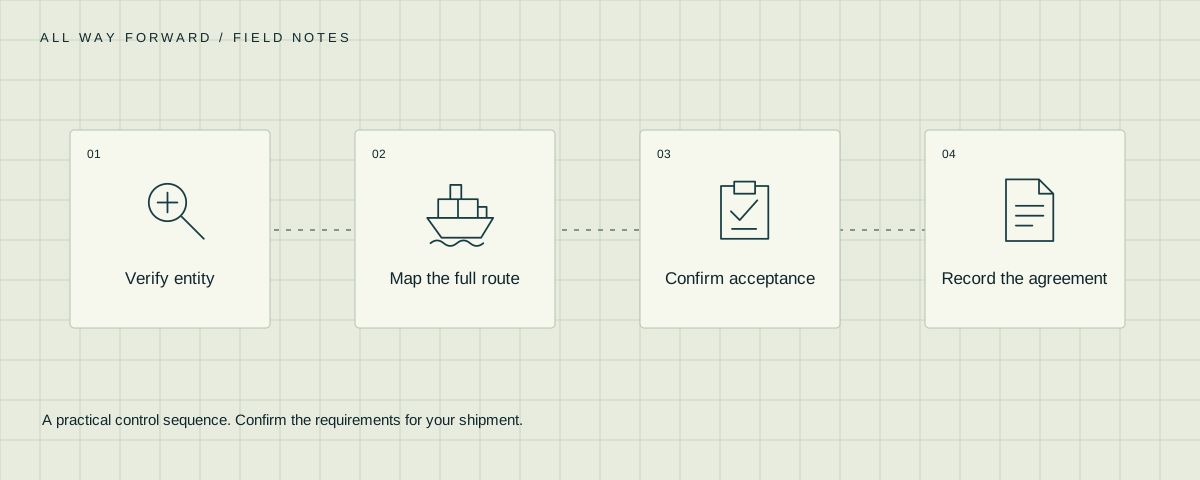
Verify the exact contracting party and the current service proposed for your shipment. Check location names and codes, routing, transshipment, destination agent and final delivery scope. A historical carrier ranking or a familiar brand name is not evidence that a specific sailing or service is available.
Identify who is contracting with you
Record the legal company name, business contact, quotation issuer and transport-document issuer. Ask whether the party acts as agent, forwarder or NVOCC for the proposed service. The logo on a quotation does not explain who is responsible for each leg.
For relevant U.S. ocean intermediary services, the FMC’s active OTI list distinguishes licensed intermediaries and registered foreign NVOCCs that meet the listed requirements. Check the actual entity and category; do not assume every foreign company needs the same U.S. license. [1] This is a regulatory-status check, not a guarantee of service quality or solvency.
Write the complete route
Use a route statement with five fields: collection address → origin receiving point → loading gateway → discharge gateway → final delivery address. Add any known transshipment point and the party responsible for an inland leg. For rail or air segments, identify the relevant terminal or airport and handoff rather than treating a seaport code as universal.
UNECE’s UN/LOCODE directory helps disambiguate trade and transport locations. [2] Still confirm the actual terminal, depot or warehouse address with the operator. A location code identifies a place; it is not proof of a booked service or a delivery commitment.
Compare the service, not a reputation anecdote
| Ask for | Why it matters |
|---|---|
| Proposed service and routing | Reveals direct and transshipment assumptions |
| Estimated milestones | Separates departure, arrival and delivery |
| Equipment acceptance | Confirms suitability for the actual cargo |
| Destination handling party | Identifies who controls release and collection |
| Exceptions and changes | Clarifies how disruptions are communicated and priced |
Old training lists can include merged or discontinued brands, obsolete routes and unsupported claims about performance. Use the current carrier or operator schedule and the actual booking confirmation. Do not promise “direct” service unless the provider confirms what that means for the booked movement.
Verify changes through an established channel
If the receiving address, release party or payment details change unexpectedly, contact a known representative using a previously verified channel. Confirm the change in writing and identify which documents or filings must be updated. Keep the old and new versions in the shipment record.
Example: a quote names a discharge port while the buyer expects delivery to a warehouse hundreds of kilometres inland. Resolve the inland leg, clearance location, unloading and price before booking. A cheap port-to-port quotation is not a substitute for the required delivery service.
Recheck the plan when the equipment or routing changes. A service that accepted ordinary boxed furniture may require separate approval for batteries, liquid products, oversize stone or other special cargo.
Use before the next handoff
Your action checklist
Ticks stay in this browser. No shipment details are sent.
Common questions
Does a port code include final delivery?
No. Confirm the final delivery address and included inland service separately from the discharge port.
Should I choose a carrier using an old ranking table?
Use current service availability and shipment-specific conditions. Historical rankings and fleet sizes do not establish suitability for your booking.
Sources & scope
Primary references checked 21 October 2026. Carrier examples describe that provider’s process; confirm the requirements of your own booking and destination.
Editorial preparation: Allwayforward Editorial Team. The worksheets and worked examples are original planning aids, not carrier forms or a substitute for shipment-specific instructions.