 Skip to content
The practical answer
Compare the cost of the same shipment scope, not just the ocean-freight line. Normalize the cargo, routing, equipment and delivery service, then list origin, transport, destination and conditional charges. Keep taxes and uncertain charges visible instead of treating missing prices as zero.
Make the quote request comparable
Give every provider the same packed dimensions, weights, piece count, commodity description, supplier addresses, cargo-ready date and final delivery address. State whether goods can be stacked and whether an appointment, liftgate, forklift or unloading crew is needed. Confirm the agreed trade term and named place separately from the forwarder’s scope.
Ask for a validity date, proposed routing and written inclusions. “All in” is a label until the quote identifies what is included. A net rate can describe pricing before commission; it does not establish a door-to-door total.
Use five cost buckets
| Bucket | Questions to resolve |
|---|---|
| Origin | Collection, warehouse receiving, packing, export handling and documentation? |
| Main transport | Freight, applicable surcharges, routing and validity? |
| Destination | Terminal or CFS handling, clearance service and delivery? |
| Government charges | Who calculates and pays duties, taxes and other assessed charges? |
| Conditional charges | Examination, storage, waiting, redelivery, amendments or cancellation? |
For every line, record the currency and unit: per shipment, document, container, cubic metre, revenue ton, kilogram, hour or day. A minimum charge can matter as much as the displayed rate. For LCL, request the actual weight/measurement basis and destination minimums; do not substitute an air-freight volumetric divisor.
Worked example: the lower freight line can cost more
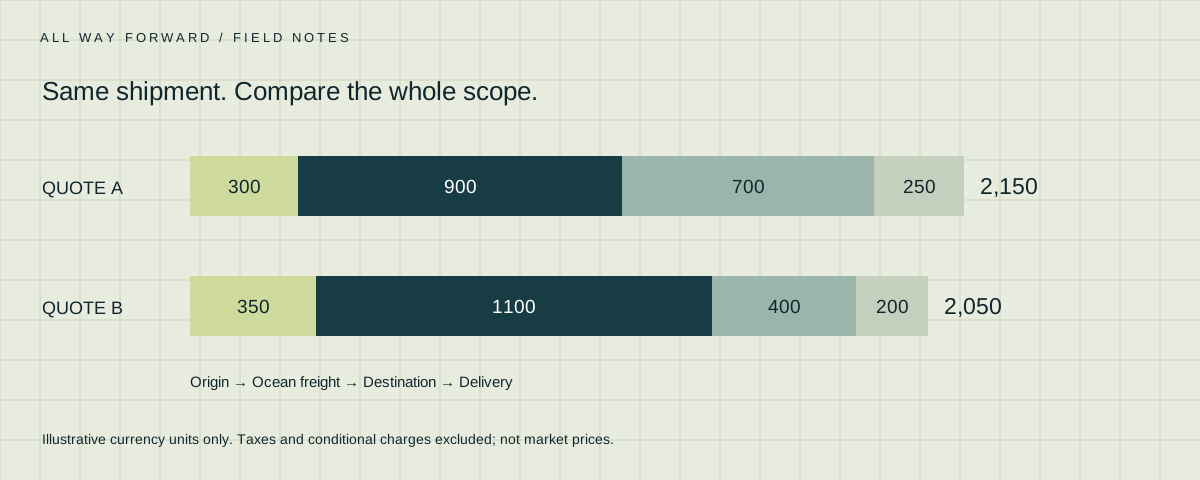
Illustrative arithmetic only; these are not market rates. Both quotes cover one identical shipment and delivery scope. Quote A lists origin 300 + ocean 900 + destination 700 + delivery 250 = 2,150 currency units. Quote B lists 350 + 1,100 + 400 + 200 = 2,050. Quote B has the higher ocean line and the lower stated total.
That comparison is valid only if the inclusions match. If A excludes a destination handling fee or B assumes a commercial loading dock, resolve that difference first. Keep a separate line for government charges and unpriced exceptions. Do not convert “TBC” into zero to make a spreadsheet look finished.
Review change and cancellation terms
Record what happens if cargo volume changes, the factory misses readiness, the booking is cancelled or a sailing changes. Cancellation, no-show or deadfreight charges depend on the accepted terms and facts. There is no universal 11 a.m. cancellation deadline or standard percentage to apply to every LCL booking. Carrier products can have specific commitments and fees; read the terms attached to the quoted product. [1]
Before accepting, ask the provider to confirm the final scope and unresolved amounts in one revised quotation. Save the version you accepted alongside the booking confirmation.
Use before the next handoff
Your action checklist
Ticks stay in this browser. No shipment details are sent.
Common questions
Is the lowest ocean rate the cheapest shipment?
Only when the remaining scope, charges and conditions are comparable. Destination handling and delivery can change the outcome.
Can I assume a 40-foot container costs twice a 20-foot container?
No. Request both current quotations for the actual service and compare equipment suitability as well as price.
Sources & scope
Primary references checked 21 October 2026. Carrier examples describe that provider’s process; confirm the requirements of your own booking and destination.
Editorial preparation: Allwayforward Editorial Team. The worksheets and worked examples are original planning aids, not carrier forms or a substitute for shipment-specific instructions.